Graphing My Home: A Review of Four Quadrant Graphing

Muse Machine 2025 Summer Institute-Inspired Lesson Plan
Developed by Angela Streby
Incarnation Catholic School
Dayton, OH

Lesson Plan Summary:

Elementary math often emphasizes equations and correct answers. Inspired by the 2025 Summer Institute Storytelling and the Folk Arts Spirit: The Roads that Lead to Home, Angela Streby of Incarnation Catholic School adapted the idea of “mapping home” into a graphing lesson. Students identified personal concepts of home and plotted them on coordinate grids, reinforcing vocabulary, axes, points, and ordered pairs while showing that accuracy can yield multiple valid answers. Student reflections confirmed the lesson’s impact on their knowledge of graphing concepts as well as deeper than expected personal connections to the work.

Instructor: Angela Streby
Title of Lesson: Graphing My Home: A Review of Four-Quadrant Graphing
Subject Area & Grade Level: PreAlgebra Grade 8
Summer Institute Inspiration: Mapping Home with Chris Westhoff

Lesson Plan PDF

Ballad of the American Dream

Muse Machine 2025 Summer Institute-Inspired Lesson Plan
Developed by Sarah Swint
David H. Ponitz CTC
Dayton, OH

Lesson Plan Summary:

Although the American Dream is a common ELA topic, its evolution over time often receives less attention. Inspired by Rick Good’s “Songs that Tell a Story” session at the 2025 Summer Institute Storytelling and the Folk Arts Spirit: The Roads that Lead to Home, Sarah Swint of David H. Ponitz CTC invited ELA 11 students to write ballad verses and choruses to the tune of “This Land Is Your Land,” reflecting on modern barriers to the Dream. The lesson sparked thoughtful analysis, energized performance, and offered this teacher insight into students’ fears and hopes for the future.

Instructor: Sarah Swint
Title of Lesson: Ballad of the American Dream
Subject Area & Grade Level: English 11
Summer Institute Inspiration: Songs that Tell a Story with Rick Good

Lesson Plan PDF

Amendments Through Music: Suffrage Ballads

Muse Machine 2025 Summer Institute-Inspired Lesson Plan
Developed by Valerie Folz
Butler Tech School of the Arts
Fairfield Township, OH

Lesson Plan Summary:

Teachers of American government often seek engaging ways to help students retain essential content. Inspired by the 2025 Summer Institute Storytelling and the Folk Arts Spirit: The Roads that Lead to Home, Valerie Folz of Butler Tech School of the Arts challenged students to write and perform ballads about suffrage amendments. Student groups researched the historical problems each amendment addressed, then composed songs to teach their peers. With choice in amendment, song, and rubric criteria, students eagerly performed their work, and Valerie’s assessments showed the ballads were both effective and engaging.

Instructor: Valerie Folz
Title of Lesson: Amendments Through Music: Suffrage Ballads
Subject Area & Grade Level: American Government, 11th Grade
Summer Institute Inspiration: Songs That Tell a Story with Rick Good

Lesson Plan PDF

How to read this Rehearsal Schedule

• You received a casting letter with a list of songs – every list is specific to that person. Each segment of a rehearsal includes a list of people who attend in parentheses. If your letter lists Fixer Upper and you see:

MON, NOV 10
4:30-8:30
Fixer Upper
(Anna, Kristoff, Olaf, Sven, Fixer Upper performers)

… then you would attend that rehearsal because Fixer Upper performers is listed in parentheses. You are matching the info in your casting letter to the parenthetical lists in the schedule.

• A handful of performers have a specific role/character name on their letter as well. Those performers will also attend when those characters are listed by name on the schedule (so you are looking for the songs on your letter and/or your character name in the schedule). Principals and understudies always attend when that character is listed.

• Sometimes actors are indicated on the schedule by their real names. Of course, you should attend if you are named in a rehearsal.

• The word “tutti” refers to the entire “older” company (but not the Young Cast). If it says tutti, you should attend. In this show, tutti also includes the Young Anna and Young Elsa actors.

• What if the schedule says that a song is being rehearsed that is on your casting letter, but the list of needed performers in parentheses doesn’t include you? That simply means that we aren’t using everyone on that particular day and you don’t need to attend.

• Most rehearsals occur in the fourth floor Muse studio. Some rehearsals occur in the Muse office on the third floor and those are tagged “on third floor.”

What do we mean by dance class?

You’ll see that many rehearsals begin with “dance class.” It is exactly that – dance training will be provided for no additional fee through the months ahead. Although it will sometimes be broadly aligned with specific dances in the show, this is general dance instruction for members of the older cast, regardless of training level. If you are in whatever song or scene immediately follows the class, you are asked to attend class that day. However, dance classes are always open to the entire older cast (ie, you are welcome to attend classes even if you’re not in that day’s other rehearsals).

Please Note

• It may be convenient to bookmark musemachine.com/backstage on your device. Tapping a month’s name on the right will auto-scroll you to that month. Remember that updates to the online schedule will occur throughout the rehearsal period, so if you print the schedule, it will become outdated.

• When updates are made to this schedule, you will be notified via voice message, the change will initially appear at the top of the Backstage page and the changes will also appear in green on this schedule. Currently, notes of interest appear in red.

• This schedule is for grades 8-12 (the “Cast”). Although there is some overlap, the younger performers (grades 2-7) have a separate schedule for “Young Cast”.

• “AIS2” means Act One, Scene Two; “AIIS3” means Act Two, Scene Three, and so on.

• Song titles appear in italic type.

• On several days throughout the rehearsal period, we will be “dark” – meaning no rehearsal. There are also breaks for Thanksgiving and in late December for the winter holidays.

• If a day simply indicates “Rehearsal” without specifying a scene or song, this indicates a complete run-through of the show (these begin in December).

• For speaking characters, be very familiar with your scene/lyrics the first time it is rehearsed. The second time any scene appears on the schedule, you should be essentially off-book (memorized) for that scene.

October

SAT, OCT 18

Vocal music sessions for selected characters/understudies

9:30-10:30  Elsa
10:30-11:00  Pabbie & Bulda
11:00-11:30  Oaken
noon-12:30  Hans
12:30-1:00  Hans & Anna
1:00-1:30  Anna
1:30-200  Anna & Kristoff
2:00-2:30  Kristoff
2:30-3:00  Olaf
All principals should bring a three-ring binder to this rehearsal!

SUN, OCT 19

Dark
In the performing arts, “dark” means no rehearsal or performance, as in “The theatre is dark on this day.”

MON, OCT 20

Dark

TUES, OCT 21

4:30-5:30
Dance class
(Tutti)
“Tutti” means the entire older cast
5:30-6:30
Show discussion
(Tutti)
6:30-8:00
Group vocals
(Tutti)
All cast members should bring a three-ring binder to this rehearsal!

WED, OCT 22

4:30-5:30
Dance class
5:30-8:30
Summer Festival
(King, Queen, Young Anna, Young Elsa, Summer Festival performers)

On third floor:
5:30-8:30
Song and character work
(Anna, Elsa, Hans, Kristoff)

THURS, OCT 23

4:30-5:30
Dance class
5:30-7:00
Summer Festival (also called “Opening”‘)
(King, Queen, Young Anna, Young Elsa, Summer Festival performers)
7:00-8:30
Summer Festival
(selected performers only: Bentley B, Clark B, Noah M, Addison C, Amari B, Amelie H, Angel J, Ellerie S, Emily S, Gwen S, Josie W, Landry N, Marin M, Tahery R, Via M)

On third floor:
5:30-7:00
AIS5 p28-32 incl Hans of the Southern Isles and AIS7 p45-50
(Anna, Hans, Kristoff, Sven, Elsa, Weselton)
7:00-8:30
AIS8 p51-57 incl Reindeers Are Better Than People & What Do You Know About Love
(Kristoff, Sven, Anna)

FRI, OCT 24

4:30-5:30
Dance class
5:30-8:30
Coronation Day
(Opulent Guests only)
Coronation Day sequence performers include “opulent guests” and “townspeople” (specified in casting letters) – sometimes they rehearse together and sometimes separately.

SAT, OCT 25

10:00-11:00
Dance class
11:00-1:00
Summer Festival
(Summer Festival performers without principals)
1:00-2:00
Lunch break
2:00-5:00
Coronation Day
(Opulent Guests only)

On third floor:
10:00-11:00
Vocal music rehearsal
(Young Anna, Young Elsa)
11:00-1:00
Scenes
(Young Anna, Young Elsa, King, Queen)
2:00-3:00
Scenes
(Young Anna, Young Elsa, King, Queen, Pabbie, Bulda)
3:00-5:00
Scenes
(Young Anna, Young Elsa)

SUN, OCT 26

1:00-2:30
Hygge vocals
(Oaken, Kristoff, Sven, Anna, Olaf, Hygge performers, Oaken)
2:30-5:00
Hygge
(Oaken, Kristoff, Sven, Anna, Olaf, Hygge performers, Oaken)

MON, OCT 27

4:30-5:00
Dance class
5:00-8:30
Hygge
(Hygge performers, Oaken; no other principals this time)

On third floor:
5:00-8:30
AIS8 & AIS9 p51-63 incl Reindeers Are Better Than People, What Do You Know About Love & In Summer
(Kristoff, Sven, Anna, Olaf)

TUES, OCT 28

4:30-5:30
Dance class
5:30-8:30
Coronation Day
(Hans, Kristoff, Sven, Elsa, Bishop, Weselton, Townspeople, Opulent Guests)

On third floor:
5:30-8:30
AIS4 incl For the First Time in Forever
(Anna, Handmaidens)

WED, OCT 29

4:30-5:00
Dance class
5:00-5:30
Lost At Sea vocals
(Lost At Sea performers; King and Queen are at rehearsal on third floor)
5:30-8:30
Lost At Sea staging
(Lost At Sea performers; King and Queen are at rehearsal on third floor)

On third floor:
5:00-8:30
AIS3 incl Do You Want to Build a Snowman?
(Young Anna, Young Elsa, King, Queen, Anna, Elsa)

THURS, OCT 30

4:30-5:00
Dance class
5:00-6:30
Vocal rehearsal
(Tutti)
6:30-8:30
Top of show through the opening of the castle gates, p1-26
(Tutti)

FRI, OCT 31

Dark
Happy Halloween!

November

SAT, NOV 1

10:00-11:00
Group vocals: Dangerous to Dream
(Elsa, Bishop, Weselton, Hans, Anna, Townspeople, Opulent Guests)
11:00-1:00
Coronation Day
(Hans, Kristoff, Sven, Bishop, Weselton, Townspeople, Opulent Guests)
1:00-2:00
Lunch break
2:00-5:00
AIS6 & AIS7 p33-36 incl Dangerous to Dream
(Anna, Elsa, Hans, Kristoff, Sven, Bishop, Weselton, Townspeople, Opulent Guests)

On third floor:
11:00-1:00
Scenes/songs review
(Anna, Elsa)

SUN, NOV 2

Noon-2:30
Read thru/sing thru
(Tutti)
2:30-3:30
AIS6 & AIS7 p33-40 Dangerous to Dream and scene until Anna & Hans step away from partygoers
(Anna, Elsa, Hans, Kristoff, Sven, Bishop, Weselton, Townspeople, Opulent Guests)

3:30-5:00 (fourth floor)
Opening/Summer Festival – Maypole sequence
(ONLY these performers: Abriella R, Addison C, Amari B, Amelie H, Angel J, Bentley B, Clark B, Cole P, Cooper S, Ellerie S., Emily S, Gavin E, Gwen S, Josie W, Linus S, Lucas B, Marin M, Nate B, Noah M, Savannah G, Via M)

3:30-5:00 (third floor)
Do You Want To Build A Snowman

(Young Anna, Young Elsa)
Note earlier start time. Remember to set any non-automated clocks back this morning!

MON, NOV 3

4:30-5:00
Dance class
5:00-8:30
Love Is An Open Door
(Anna, Hans, Love Is An Open Door performers )

TUES, NOV 4

4:30-5:00
Dance class
5:00-8:30
Love Is An Open Door
(Anna, Hans, Love Is An Open Door performers )

On third floor:
5:00-6:30
Let It Go & Monster
(Elsa)
Election Day (if you need to arrive late so that you can vote, please just indicate this on an excused absence form)

WED, NOV 5

4:30-6:00
AIIS2 p77-85 incl Let It Go (Reprise)
(Kristoff, Anna, Sven, Olaf, Elsa)
6:00-7:30
AIIS3 p86-89 incl Do You Want To Build A Snowman? (Reprise) & Kristoff Joik
(Kristoff, Anna, Sven, Olaf)
7:30-8:30
AIIS4 p90-91 scene preceding Fixer Upper
(Kristoff, Anna, Sven, Olaf, Pabbie, Bulda)

THURS, NOV 6

4:30-5:30
Dance class
5:30-8:30
AIS7 p40-45 Hans & Anna scene and Love Is An Open Door
(Anna, Hans, Love Is An Open Door performers)

FRI, NOV 7

On third floor:
4:30-6:00
AIS9 incl In Summer
(Anna, Kristoff, Sven, Olaf)

On fourth floor:
6:00-7:30
AIIS4 p95-97 incl Kristoff Lullaby
(Kristoff, Anna, Sven, Olaf, Pabbie, Bulda)
7:30-8:30
AIS9 incl In Summer
(Anna, Kristoff, Sven, Olaf)

SAT, NOV 8

Dark

SUN, NOV 9

noon-2:00
Fixer Upper
(only Pabbie, Bulda, Kristoff, Anna)
2:00-5:00

Fixer Upper
(Pabbie, Bulda, Kristoff, Anna, Sven, Fixer Upper performers)
5:00-6:00
Costume Measurements & Parent Meeting
Meeting for parents of all cast/young cast/PAs/orchestra. Also, costume measurements for all cast members. Young cast members will be measured at a different time, but their parents should attend the meeting. Please note the different start time on this day.

MON, NOV 10

4:30-8:30
Fixer Upper
(Pabbie, Bulda, Kristoff, Sven, Anna, Olaf, Fixer Upper performers)

TUES, NOV 11

4:30-6:30
AIS10 p64-67
(Hans, Weselton, Lackey, Search Party)
6:30-8:30
AIIS5, 6, 7 p98-104 incl Monster
(Hans, Weselton, Lackey, Search Party, Elsa, Kristoff, Anna, Olaf, Sven)

WED, NOV 12

4:30-4:45
Dance Class & Vocal Warmup

4:45-8:30
Rehearsal
(Tutti)
“Rehearsal” means we will run the entire show (in this case, we will run selected scenes and numbers) 

THURS, NOV 13

4:30-5:30
Fixer Upper
(Pabbie, Bulda, Kristoff, Sven, Anna, Olaf, Fixer Upper performers)
5:30-6:30
Cornation Day
(Hans, Kristoff, Sven, Bishop, Weselton, Townspeople, Opulent Guests)
6:30-7:30
Hygge
(Oaken, Anna, Kristoff, Sven, Olaf, Hygge performers)
7:30-8:30
Summer Festival
(Young Anna, Young Elsa, King, Queen, Summer Festival performers)

FRI, NOV 14

Dark

SAT, NOV 15

10:00-1:00 (on fourth floor)
Coronation Tango
(Abriella R, Addison H, Amee H, Cole P, Connor C, Gwen S, Herbert B, Jax H, Kara S, Linus S)

10:00-11:30 (on third floor)
A Little Bit Of You & Do You Want To Build A Snowman?
(Young Anna, Young Elsa)

11:30-1:00 (on third floor)
Monster
(Elsa)

1:00-2:00
Lunch

2:00-5:00 (on fourth floor)
AIIS9 p109-113 Colder By The Minute
(Anna, Kristoff, Hans, Elsa, Search Party)

2:00-4:00 (on third floor)
AIIS4 p90-92 incl beginning of Fixer Upper; also p95-97
(Pabbie, Bulda, Kristoff, Anna, Sven, Olaf)

SUN, NOV 16

1:00-5:00
Act One, part one – p1-35
(Tutti)

MON, NOV 17

4:30-8:30
Act One, part two – p36-69
(Tutti)

TUES, NOV 18

4:30-8:30
Act Two, part one – p70-97
(Tutti)

WED, NOV 19

4:30-8:30
Act Two, part two – p98-117
(Tutti)

THURS, NOV 20

Dark (only Young Cast rehearses this day)

FRI, NOV 21

Dark

SAT, NOV 22

This morning is the Advance Ticket Sale for families of cast, orchestra and PAs. Complete details here.

This day is also the first beverage drop off. Please bring two cases of water, soda or sports drink and a volunteer will collect the beverages from your car. Beverages will be used for upcoming student meals — thank you!

9:30-10:30
Dance class
10:30-12:00
Rehearsal
(Tutti)
12:00-1:00 
Lunch break
1:00-5:00
Rehearsal
(Tutti)

A peace rally will occur at 1:00. In the interest of minimizing traffic challenges, we have moved the lunch break to noon and we suggest cast members consider bringing lunch (or making a quick lunch pick-up and returning to the Muse space). 

SUN, NOV 23

1:00-5:00
Rehearsal
(Tutti)

MON, NOV 24

4:30-6:30
Hygge & Opening/Summer Festival
(Hygge performers, Opening/Summer Festival performers + Young Cast together)
6:30-8:30
End of show sequence
(Tutti)

TUES, NOV 25

4:30-8:30
Rehearsal
(Tutti)
Happy birthday, Joe Deer!

WED, NOV 26–SUN, NOV 30

Holiday Break
Happy Thanksgiving!

December

MON, DEC 1

4:30-8:30
Act One
(Tutti)

TUES, DEC 2

4:30-8:30
Act Two
(Tutti)

WED, DEC 3

4:30-8:30
Rehearsal
(Tutti)

THURS, DEC 4

4:30-8:30
Rehearsal & create preview performance
(Tutti)

FRI, DEC 5

Dark

SAT, DEC 6

10:00-11:30
End This Winter, Colder by the Minute, Dangerous to Dream, Coronation Tango, Love Is an Open Door, and all background staging/choreography for Opulent Guests
(All participants in any of the scenes/dances listed above)
11:30-1:00
Opening/Summer Festival, Lost at Sea, Fixer Upper
Please note the different end time on this day. Also, please try to make yourself available this mornig for a brief costume fitting at a time when you are not not personally needed at rehearsal)

SUN, DEC 7

1:00-5:00
Preview rehearsal & set-up
(Tutti)

MON, DEC 8

4:30-6:30
Preview rehearsal and various review
(Tutti)
6:30-7:30
Preview Performance
Please note the different end time on this day.

TUES, DEC 9

4:30-5:00
Dance class
5:00-8:30
Megamix
(Tutti)

WED, DEC 10

4:30-5:00
Dance class
5:00-8:30
Megamix & bows
(Tutti)

THURS, DEC 11

4:30-6:30
Hygge & Opening/Summer Festival
(Hygge performers, Opening/Summer Festival performers + Young Cast together)
6:30-8:30
Dance class with special guest artist
(Tutti)

FRI, DEC 12

Dark

SAT, DEC 13

Rehearsal Cancelled

10:00-12:00
Dance review
(Tutti)
12:00-1:00
Lunch break
1:00-5:00
Sitzprobe
(Tutti)
The Sitzprobe is a concert version of the musical numbers from the show combining the cast and orchestra. Actors will be pulled down for costume fittings throughout the rehearsal. Please dress accordingly.

SUN, DEC 14

noon-4:00
Sitzprobe
(Tutti)
The Sitzprobe is a concert version of the musical numbers from the show combining the cast and orchestra. Actors will be pulled down for costume fittings throughout the rehearsal. Please dress accordingly.

Please note different end time on this day.

The Winter Party & Dance and the second beverage pick-up have been rescheduled for Jan 3.

MON, DEC 15

4:30-8:30
Rehearsal (AI & AII)
(Tutti)

TUES, DEC 16

4:30-8:30
Rehearsal – understudy focus
(Tutti)

WED, DEC 17

5:00-7:00
Updated staging for AIS8 incl What Do You Know About Love
(Anna, Kristoff, Sven)

The Understudy Performance has been rescheduled to Jan 5.

THURS, DEC 18

No cast rehearsal (orchestra rehearsal only)

FRI, DEC 19—FRI, JAN 2

Winter Break
Merry Christmas!
Happy Hanukkah!

Happy Kwanzaa!
Happy New Year!

January

SAT, JAN 3

10:00-noon
Rehearsal
(Tutti)
noon-1:00
Lunch
1:00-4:00
Rehearsal
(Tutti)

This day is the rescheduled second beverage drop off. Please bring two cases of water, soda or sports drink and when you drop your student outside the Muse building, a volunteer will collect the beverages from your car. Beverages will be used for upcoming student meals — thank you!

Parents who are bringing food for the Winter Party & Dance may also drop the food curbside prior to rehearsal when they drop off students, at the same time as the beverage drop. 

Rescheduled: The Winter Party & Dance is this evening from 6-9pm at the Packard Museum. Info & tickets here.

SUN, JAN 4

1:00-5:00
Rehearsal
(Tutti)

MON, JAN 5

4:30-5:30
Rehearsal
(Tutti)
5:30-8:30
Understudy Performance
(Tutti)
This is the rescheduled Understudy Performance. Families of the understudy cast are invited to attend via RSVP via this link. Non-flash photos are welcome (no video).

TUES, JAN 6

4:30-8:30
Rehearsal
(Tutti)

WED, JAN 7

4:30-8:30
Rehearsal
(Tutti)

THURS, JAN 8

4:30-10:00
Rehearsal: primarily Act One spacing
(Tutti)
• Most remaining rehearsals are held at the Victoria Theatre.
• On this day, come to the Muse studio first.
• You will always leave at the end of the night from the Muse studio (even when we rehearse at the Victoria).
• Do not bring anything that isn’t absolutely necessary to the remaining rehearsals. Items forgotten in the Victoria Theatre cannot be retrieved until the next day (including car keys, school work, etc).
• Only water is permitted in the theatre (no other beverages). You may leave snacks (w your name) in a specific area adjacent to the theatre. Bring items that don’t require refrigeration or heat.

FRI, JAN 9

5:00-10:00
Rehearsal: primarily Act Two spacing
(Tutti)
Report directly to the Victoria Theatre. When reporting to the Victoria, always arrive 15-20 minutes before the beginning of rehearsal (not earlier or later). If you need to arrive earlier, go to the Muse studio first.

SAT, JAN 10

Noon10:00pm
Tech Rehearsal (Act One x2) with costumes and make-up
(Older cast)
Dinner provided between rehearsals, 4:00-5:00.

SUN, JAN 11

Noon-10:00pm
Tech Rehearsal (Act Two x2) with costumes and make-up
(Older cast)
Dinner provided between rehearsals, 4:00-5:00.

MON, JAN 12

4:30-5:30
Colder by the Minute
(All cast members involved in the Colder by the Minute sequence)

TUES, JAN 13

5:00-10:00
Rehearsal with tech, costumes and make-up
(Older cast)

WED, JAN 14

5:00-10:00
Rehearsal with tech, costumes and make-up
(Older cast)

THURS, JAN 15

Performance (Opening Night)
5:30: Dance warmup in Muse studio
6:00: Get into costumes and makeup at Victoria Theatre
6:45: Vocal warmup on stage
7:00: Curtain (“Curtain” is the time the performance begins)
10:45: Cast released (approx)

FRI, JAN 16

Performance
6:00: Dance warmup in Muse studio
6:30: Get into costumes and makeup at Victoria Theatre
7:15: Vocal warmup on stage
7:30: Curtain
10:15: Cast released

SAT, JAN 17

Two performances
1:00: Dance warmup in Muse studio
1:30: Get into costumes and makeup at Victoria Theatre
2:15: Vocal warmup on stage
2:30: Curtain
*Dinner provided between performances
6:30: Get into costumes and makeup at Victoria Theatre
7:15: Vocal warmup on stage
7:30: Curtain
10:15: Cast released

SUN, JAN 18

Performance (Closing Performance)
12:30: Dance warmup in Muse studio
1:00: Get into costumes and makeup at Victoria Theatre
1:45: Vocal warmup on stage
2:00: Curtain
4:30: Cast released

Concert Outfits 2025

Cast (gr 8-alumni)

Cast members should bring all outfit pieces to rehearsal on Sat, Aug 9. These will stay at Muse or the Victoria Theatre until the concert is over.

The older cast of the concert essentially has two outfits to bring in…

OUTFIT 1 — SHADES OF BLUE: Casual + Cool + Dance-Ready

Color palette: Primarily shades of blue (dark, light, all shades). White accents are ok. Subtle patterns are ok. No text/words or large logos.

If you wear a t-shirt, layer another shirt over it (aka: a t-shirt cannot be your only shirt).

No shorts.

Try: button-ups, knits, summer vacation-inspired looks. Layered looks are good too.

Dresses/skirts OK (must be appropriate for dancing — not too short).

Footwear: White shoes (like sneakers or Keds) required (clean & dance-appropriate). Wear short, white ankle/no-show socks.

No holes/tears in denim.

Must allow for comfortable movement and choreography.

OUTFIT 2 — COLORFUL CONTRAST: Bold + Bright + Dramatic Shift

Color palette: Vibrant and contrasting with Outfit 1.

Same style & movement rules apply as above: no shorts, t-shirts should have other shirts layered, subtle patterns are ok.

Clothes must be danceable and practical.

Footwear: Same white tennis shoes.

Think transformation! This should feel like a big visual change from the first look.

SEND OUTFIT PHOTOS ASAP

Take well-lit, full-body photos of both looks. If you need to take a photo in the mirror, that is ok too.

Send to: muse.costumes@gmail.com

We’ll respond if anything needs to change. Questions? Reach out via email muse.costumes@gmail.com — we’re here to help!


Cast (gr 3-7)

Young cast members should wear their outfits to the rehearsal on Sun, Aug 10 at 3:00. They will wear them home and wear them to and from the Victoria Theatre on Mon, Tues and Wed (see schedule). 

The young cast of the concert has one outfit to bring in…

YOUNG CAST OUTFIT — SHADES OF BLUE: Casual + Cool + Dance-Ready

Color palette: Primarily shades of blue (dark, light, all shades). White accents are ok. Subtle patterns are ok. No text/words or large logos.

If you wear a t-shirt, layer another shirt over it (aka: a t-shirt cannot be your only shirt).

MUST wear shorts.

Try: button-ups, knits, summer vacation-inspired looks. Layered looks are good too.

Footwear: White shoes (like sneakers or Keds) required (clean & dance-appropriate). Wear short white ankle/no-show socks.

No holes/tears in denim.

Must allow for comfortable movement and choreography.

Please style hair prior to arrival (aka mostly out of their faces).

YOUNG CAST DO NOT NEED TO SEND PHOTOS

We’ll respond if anything needs to change. Questions? Reach out via email muse.costumes@gmail.com — we’re here to help!


Featured Soloists or Dancers

Soloists/featured dancers should bring all outfit pieces to rehearsal on Sat, Aug 9. These will stay at Muse or the Victoria Theatre until the concert is over.

Those in featured dance groups or with vocal solos should get costume direction from Doug or Lula.


Musicians

Orchestra members dress entirely in black. It does not need to be formal, but please look nice. Please wear black outfit EVERY time we are in the Victoria (photos/videos will also be taken on Mon and Tues).


Concert Dance Schedule

• This schedule is for dancers featured in selected songs.

• Rehearsals are in the Muse Studio (fourth floor of the Metropolitan Arts Center), unless otherwise specified.

• If you have a featured vocal rehearsal at the same time as a dance rehearsal, you’ll just step out of the dance rehearsal briefly, meet with Jeff to sing, and then return to the dance rehearsal.

• Changes will appear in green

• If you will be late or cannot attend a rehearsal (even if it was on your conflict sheet), please email lula2muse@gmail.com

July

SAT, JULY 26

10:30-noon
Sunshine dancers

1:00-2:30
Moonlight dancers

SUN, JULY 27

1:00-3:30
Finale dancers

MON, JULY 28

4:00-5:30
I Want You Back dancers

5:40-6:40
Hangin’ On dancers

TUES, JULY 29

6:30-8:00
Remember Me dancers

WED, JULY 30

12:00-1:00
Trials dancers

1:00-3:00
Finale dancers

8:00-9:30
I Want You Back dancers
Hangin’ On dancers

August

SAT, AUG 2

10:00-1:00
Finale dancers

SUN, AUG 3

4:30-5:00 (following cast rehearsal)
I Want You Back dancers
Hangin’ On
 dancers

5:00-6:00
Remember Me dancers

6:00-7:00
Moonlight dancers

MON, AUG 4

5:30-6:15
Sunshine dancers

6:15-7:30
Finale dancers

WED, AUG 6

4:30-5:30
Finale dancers

8:00-9:00 (following cast rehearsal)
Remember Me dancers
I Want You Back dancers
Moonlight dancers

FRI, AUG 8

No dance rehearsal on this Friday


Dancers by Song

FINALE

Amber T
Aurora C
Ben J
Connor C
Cooper S
David H
Eli R
Emily S
Emerson B
Gavin P
Greysen T
Griffin G
Jack W
Josiah W
Kennedy J
Lily W
Madeleine L
Maggie W
Noah M
Nora S
Reese H
Sasha T
Savannah G
Tres O
Vanessa H

HANGIN’ ON

Abbey S*
Amber T*
Aurora C
Chloe P*
Emerson B*
Emily S*
Emmaline S*
Kennedy J
Lily W
Maggie W
Megan R*
Reese H
Sadie H
Tara B*
Vanessa H
Taylor W*

I WANT YOU BACK

Ben J
Cooper S
David H
Eli R
Griffin G
Jack W
Jax H
Josiah W
Tres O

MOONLIGHT

Aurora C
Ben H
Ben J
Connor C
Cooper S
David H
Eli R
Emily S
Emerson B
Emmaline S
Faye Y
Graysen T
Griffin G
Haylie C
Jack W
Jennifer C
Josiah W
Lily W
Maggie W
Savanna G
Tres O
Vanessa H

REMEMBER ME

Amari B
Ben H
Ben J
Ben S
Brooke K
Chloe P
Cooper S
David H
Eli R
Evie W
Gavin P
Griffin G
Haylie C
Jack W
Josiah W
Kennedy J
Kyle M
Laila B
Madeleine L
Megan R
Tara B
Sasha T
Sophia R

SUNSHINE

Amber T
Aurora C
Ben J
Brooke K
Connor C
Cooper S
David H
Eli R
Emily S
Emerson B
Gavin P
Graysen T
Griffin G
Jack W
Josiah W
Keegan R
Lily W
Madeleine L
Maggie W
Noah M
Nora S
Sasha T
Savanna G
Vanessa H

TRIALS

Aurora C
Josiah W


Concert Rehearsal Schedule (Young Cast)

• This schedule is for singers/dancers in grades 3-8 (who we’ll refer to as Young Cast”).

• Rehearsals are in the Muse Studio (fourth floor of the Metropolitan Arts Center), unless otherwise specified. Parents may wait on the third floor during the young cast rehearsals in the Muse Studio or may pick them up in front of the building. For the Victoria Theatre rehearsals, parents must drop off and pick up their children (unless they are part of the volunteer team helping with the kids). More info coming soon.

• Updates to the schedule will appear in green.

August

MON, AUG 4

10:00-Noon
Young Cast rehearsal

TUES, AUG 5

10:00-Noon
Young Cast rehearsal

WED, AUG 6

10:00-Noon
Young Cast rehearsal

THURS, AUG 7

10:00-Noon
Young Cast rehearsal

FRI, AUG 8

10:00-Noon
Young Cast rehearsal

SUN, AUG 10

3:00-4:00
Young Cast rehearsal with Cast & Orchestra (Young Cast songs will be run first). 

Young Cast should arrive in costume for this Sunday rehearsal.

MON, AUG 11

6:00-8:00
Young Cast rehearsal at the Victoria Theatre (older cast rehearses until 10pm but Young Cast will leave at 8pm). See drop-off/exiting details for Victoria Theatre rehearsals and performance at bottom of schedule. 

TUES, AUG 12

6:00-8:00
Young Cast rehearsal at the Victoria Theatre (older cast rehearses until 10pm but Young Cast will leave at 8pm). See drop-off/exiting details for Victoria Theatre rehearsals and performance at bottom of schedule. 

WED, AUG 13

6:30 Cast, Young Cast & Orchestra call time at the Victoria Theatre
7:30 Performance
9:00 End (approx)

For our three days at the Victoria Theatre (Aug 11, 12 & 13), the kids will enter directly through the Victoria Stage Door (this is to the left of the door you entered for Muse rehearsals).

They should arrive already in costume and with hair styled for the show (aka, mostly out of their faces). 

Parents may walk their kids to that stage door and see them in, but parents will not be able to enter the backstage area.

Kids will identify themselves by name to the security person posted at that entrance. 

Immediately after the Victoria rehearsals and after the performance, the Young Cast will be escorted next door to the first floor of the Metropolitan Arts Center (this is “the Muse building” where you bring the kids for rehearsals). Parents must come into the building and collect their children in person (with a large audience exiting, there isn’t a safe way to release kids to the street).

Thanks for helping to make this a wonderful and safe experience for all the kids!

Concert Rehearsal Schedule

• This schedule is for singers/dancers in grades 9 through alumni (who we’ll refer to as “cast”) as well as orchestra members.

• If you auditioned (dance or vocal) or opted into the production, please attend when it says “cast.” Orchestra should attend when it indicates “orchestra.”

• Rehearsals are in the Muse Studio (fourth floor of the Metropolitan Arts Center), unless otherwise specified.

• Updates to the schedule will appear in green.

• Featured dance rehearsals appear on a different schedule, as do rehearsals for the Young Cast.

July

SUN, JUL 27

4:00-6:30
Orchestra rehearsal

TUES, JUL 29

4:00-6:30
Orchestra rehearsal

WED, JUL 30

5:30-8:00
Cast rehearsal: Bring a three-ring binder!

THURS, JUL 31

4:00-6:30
Orchestra rehearsal

August

FRI, AUG 1

5:30-8:00
Cast rehearsal Bring a three-ring binder!

SUN, AUG 3

1:00-4:00
Cast rehearsal

TUES, AUG 5

4:00-6:30
Orchestra rehearsal

WED, AUG 6

5:30-8:00
Cast rehearsal

THURS, AUG 7

4:30-7:00
Orchestra rehearsal
5:30-8:00
Cast rehearsal

SAT, AUG 9

3:00-7:00
Cast rehearsal

5:00-7:00
Combined orchestra & cast rehearsal (orch joins at 5:00)

SUN, AUG 10

3:00-7:00
Cast rehearsal

5:00-7:00
Combined orchestra & cast rehearsal (orch joins at 5:00)

MON, AUG 11

6:00-10:00
Cast & Orchestra rehearsal at the Victoria Theatre

TUES, AUG 12

6:00-10:00
Cast & Orchestra rehearsal at the Victoria Theatre

WED, AUG 13

6:30 Cast & Orchestra call time at the Victoria Theatre
7:30 Performance
9:00 End (approx)


Electoral College Meets Battle of the Bands

Developed by Val Folz
Butler Tech School of the Arts
Fairfield Township, OH

This lesson plan is available as a printable PDF (link)

Lesson Plan Summary:

Inspired by Muse Machine’s 2024 Summer Institute: Get in the Groove! Foundations for a Funky Classroom, this lesson by high school social studies Val Folz uses a Battle of the Bands competition to teach a fundamental standard of American History. Students create a scoring system based on the Electoral College for a schoolwide music competition. After learning how the Electoral College works, students choose performance categories representing Battleground States and then create a scoring grid aligned with them. The lesson’s timing coincided with a Presidential election, but its application is timeless. This lesson is easily adaptable to any project where scoring results are chosen and measured and is effective because students must understand the electoral process to prioritize the criteria.

Instructor: Valerie Folz, Butler Tech School of the Arts
Title of Lesson: Electoral College Meets Battle of the Bands
Date of Implementation: August 2024
Subject Area & Grade Level: Government, grades 11 and 12
Summer Institute Inspiration: Dayton Funk’s tradition as a Battle of the Bands

OVERVIEW OF THE LESSON

Summary:

Students will create and participate in a system for scoring Battle of the Bands that mirrors the U.S. Government’s Electoral College.

Standards:

Ohio’s Learning Standards: Social Studies, Social and Emotional
American Government, Basic Principles of the U.S. Constitution Content Statement 11: Constitutional amendments have altered provisions for the structure and functions of the federal government

SEL Competency C: Social Awareness C3: Demonstrate an awareness and respect for human dignity, including the similarities and differences of all people, groups and cultures; C4: Read social cues and respond constructively.

SEL Competency D: Relationship Skills D1: Apply positive verbal and non-verbal communication and social skills to interact effectively with others and in groups.

SEL Competency E: Responsible Decision-Making E4: Explore and approach new situations with an open mind and curiosity while recognizing that some outcomes are not certain or comfortable.

Objectives & Outcomes:

Objectives

Students will…

  • Identify factors leading to Dayton becoming the birthplace of funk music and explain how Battle of the Band competitions fueled funk’s development by watching a clip from a documentary and debriefing as a whole group.
  • Define the following terms: Electoral College, Electors, battleground or swing states, popular vote, safe state, political parties, Donald Trump, Kamala Harris, and battle of the bands.
  • Create their own version of the Electoral College by writing a Battle of the Bands ballot.
  • Strategize how to win Battle of the Bands by taking lessons for the Trump and Harris campaign teams.

Outcomes

Students will be able to share ideas with a team and strategize how to achieve common goals by rewriting the Electoral College rules with their band and strategically approaching the competition like a Presidential candidate.

Teaching Approach(es):

  • Small group
  • Whole group discussion
  • Video excerpts and discussion

Assessment Tool(s):

  • Kahoot
  • Brainstorm recording
  • Student entrance ticket
  • Teacher check-in with students during group planning
  • Student survey
  • Sentence stem reflections

ENDURING UNDERSTANDINGS

  1. I can use political ideas and actions in other areas of my life, and in doing so better understand political ideas and actions.
  2. I can read social cues and respond constructively.
  3. I can demonstrate an awareness and respect for human dignity.
  4. I can explore and approach new situations with an open mind and curiosity while recognizing that some outcomes are not certain or comfortable.

LESSON PREPARATION

Teacher Needs:

Teacher Context & Research

Helpful Hints

  1. When students are working in band groups, establish guidelines for everyone facing every other group member; require at least two juniors to speak first in a brainstorming session to promote equity.
  2. Give students as much time as possible to interact with each other to problem solve and practice social emotional skills.
  3. In general, this lesson’s time frame is tight so adding additional time or starting promptly at the top of the bell will be paramount to reaching all goals.
  4. After students learn how the Harris and Trump campaigns are strategizing to win voters in swing states, student bands will have opportunities to strategize for Battle of the Bands. To help students, scaffold strategizing by asking the whole class what actions Harris and Trump were taking and generate examples for what that might look like at SOA. Then, in small groups students will have specific ideas as a starting point for their own approach.

Student Needs:

Prior Knowledge

This lesson is designed to be implemented at the beginning of a school year, so no prior knowledge about content vocabulary is required. However, background knowledge about the Presidential election is helpful. Students will all bring with them unique feelings about the Presidential election, but most high school students are forming their political identities and excited to learn current events to grow in confidence about their identity.

Regarding the funk competition piece, students need to be coached to trust the process and feel comfortable trying something new, in a new environment and probably out of their comfort zone. Students will have knowledge of their home school cultures, but only the seniors will understand it is normal at Butler Tech School of the Arts to take risks, and we support each other for doing so by giving attention to performers, explaining our understandings to each other, and providing feedback in a growth mindset framing.

Finally, some students will have background knowledge about funk music and Southwest Ohio’s ties to the genre, while others will not. It’s important to give everyone an opportunity to learn about and celebrate Dayton funk because one’s community is a part of their identity, and this can be a source of pride for all.

To get a better understanding of how this lesson fits with the lessons of my colleagues to build a school community, please see this slide deck (link).

Student Voice

They will be able to share their ideas with their peers daily as they learn and move through the essential questions in dialogue and assessment activities. This will help them develop their understanding of the content, relate it to their lives, build relationships with others, and identify what they’re unsure of.

Second, students will be able to influence how the Battle of the Bands is structured and judged. Students will brainstorm ideas with their bands for an initial proposal for how the Electoral College rules will transfer to our funk competition, and then students will also be able to edit what I create based on all group proposals.

At the end of the entire experience, students will provide feedback in a survey that will inform how future activities like this take place at our school. Students will have a voice within the lesson and within the building culture moving forward.

Vocabulary

  • Electoral College: A body of people representing the states of the US, who formally cast votes for the election of the president and vice president
  • Electors: People chosen by their political party to elect the president and vice president based on the vote in their state
  • Popular vote: An act of voting by all the people in a country or area; the choice expressed through the votes cast by the electorate
  • Battleground state/swing state: A US state where the two major political parties have similar levels of support among voters
  • Safe state: A US state where one major political party has a clear advantage in its support among voters
  • Donald Trump: The Republican nominee for President in the 2024 election cycle
  • Kamala Harris: The Democratic nominee for President in the 2024 election cycle
  • Battle of the Bands: A high school competition in Dayton in the 1960s and 1970s that became a fertile environment for many young funk acts; a competition between bands where the audience votes for their favorite

EVIDENCE OF OUTCOMES

There are formative assessments that gauge student understanding as this lesson progresses.

On Day One students will identify factors that contribute to Dayton becoming the birthplace of funk as a whole group, and then individually reflect on their introductory knowledge with sentence stems as they exit. The purpose of this assessment is for students to learn about the factors that helped cause funk to emerge in Dayton. This content provides the “why?” explanation for focusing on the genre of funk, instills local pride, and showcases some history and cause/effect content that can be helpful in forming political identity.

On Day Two, learning about the Electoral College will be evaluated. Students will play a Kahoot to judge their understanding of the basic components. Any misconceptions should be addressed immediately. Kahoot can help build relationships because it’s a game while also preparing students for the Ohio American Government End of Course Exam because of its multiple-choice format. Later in the lesson, students will transfer their knowledge of the election process to how Battle of the Bands should be scored. This activity requires students to thoroughly understand the election process because they will be creating a new scoring system based off it. If their ideas don’t mirror the Electoral College, it’s evidence that clarity is needed. Creating something new is challenging and takes time. Students should brainstorm as a group to build social emotional skills and help each other if there are gaps in content knowledge.

On Day Three, an entrance ticket will be given to address any misconceptions discovered based on assessment data during days one and two. Touch base on any lingering questions that remain. After students learn how the Harris and Trump campaigns are strategizing to win voters in swing states, student bands will have opportunities to strategize for Battle of the Bands. To help students, scaffold strategizing by asking the whole class what actions Harris and Trump were taking and generate examples for what that might look like at SOA. Circulate once bands have an opportunity to strategize themselves to judge how students are applying content in their competition, offering support where needed.

LEARNING PLAN

Teaching Inquiry Question

How can Dayton funk’s Battle of the Bands tradition help students understand the Electoral College?

Essential Questions

  1. What factors led to Dayton becoming the birthplace of funk music?
  2. How does the way a competition is scored change the approach of participants?
  3. How can I apply strategies of political campaigns to competitions I am in?
  4. How can I work with others to showcase our group strengths as we achieve our goals?

Resources/Materials

Hook

Daily hooks will be implemented in the form of a bell ringer small group, and then whole group discussion.

Main Lesson Narrative/Sequence

Day 1 (28 minutes)

Daily Goals: Identify factors that contributed to Dayton, Ohio being a birthplace of funk music; Unpack end goals for SOA Groove

Bell Ringer: If you could be a gold medal Olympian, which sport would you choose?

Activities:

1. Discuss the bell ringer question in small groups and then have approximately 4 students share out to the whole group. Explain that today we’ll see how competition in art can fuel creativity and create community, like the Olympics.

2. Watch clip (2:04-5:25) from the University of Dayton student documentary on Dayton funk that explains how Dayton became fertile for the birth of funk and the role the Battle of the Bands had in motivating musicians.

3. As a class, identify factors that contributed to Dayton’s birth of funk, especially noting the role of the Battle of the Bands.

4. Have students turn and talk to their classmates: Think of a time when you’ve been in a competition. What did you get out of that experience?

5. Explain that the SOA Groove workshops will lead to a Battle of the Bands in eight days. Ask students what political competition is underway right now (November election campaigns, especially the Presidential election). Inform students that the school Battle of the Bands competition will be scored in a similar manner to how the U.S. elects its President and Vice President.

6. Have students reflect by completing one of the following sentence stems:

a) One thing I learned in this session is…

b) After this workshop I feel…

c) This workshop reminded me…

d) One question I have is…

Day 2 (34 minutes)

Daily Goals: Understand the Electoral College; Brainstorm Battle of the Band judging that mirrors the Electoral College

Bell Ringer: What states or countries do you plan to live in as an adult?

Activities:

1. Discuss the bell ringer question in small groups and then have approximately 4 students share out to the whole group. Explain that where one lives impacts the influence of their vote for the U.S. President because of the Electoral College.

2. Pass out the handout on the Electoral College and show students the TEDEd video so students can get an overview of the process. Stop the video at key points to explain how the electoral votes are distributed; how many votes are required to win; how this process influences campaign strategy; and how Ohio’s position has changed since the video was created. Ask what questions students have.

3. Check for understanding with Kahoot.

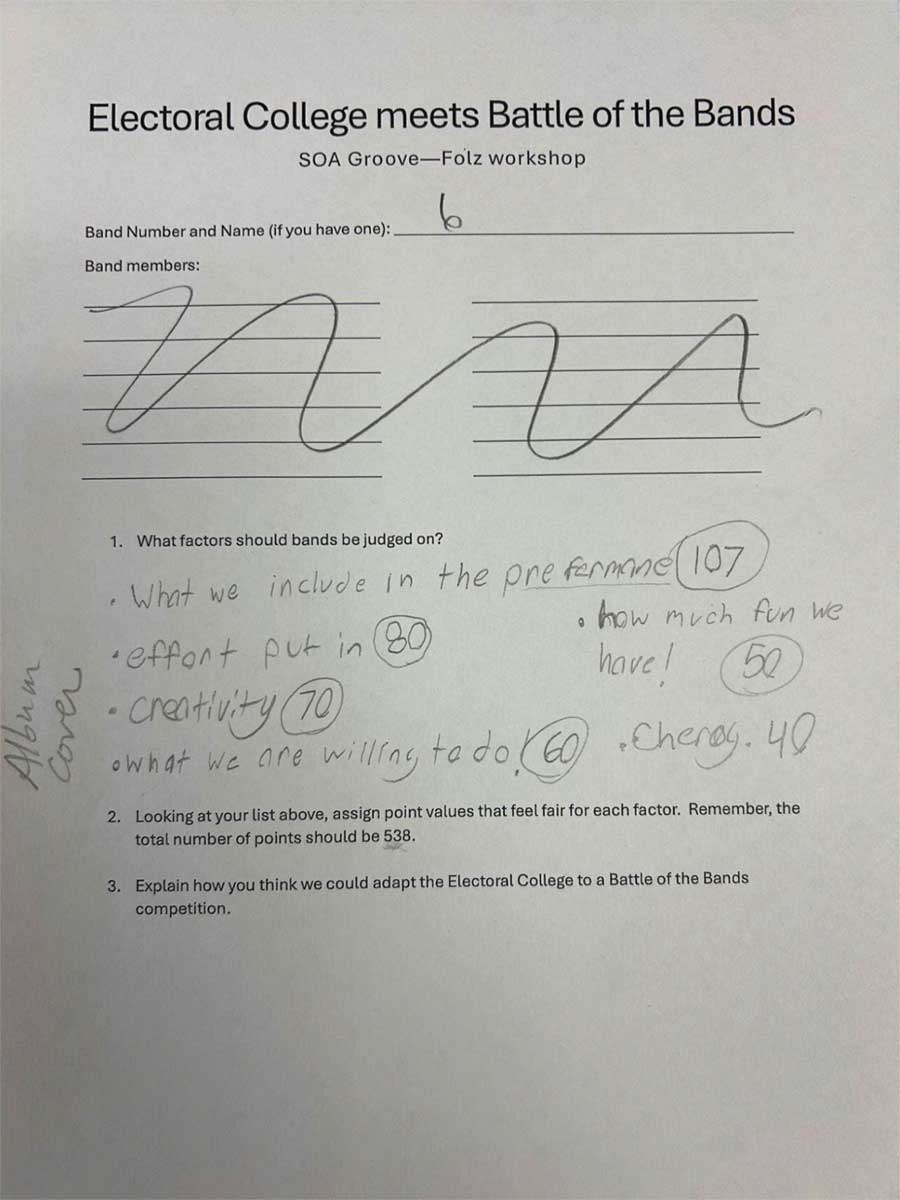
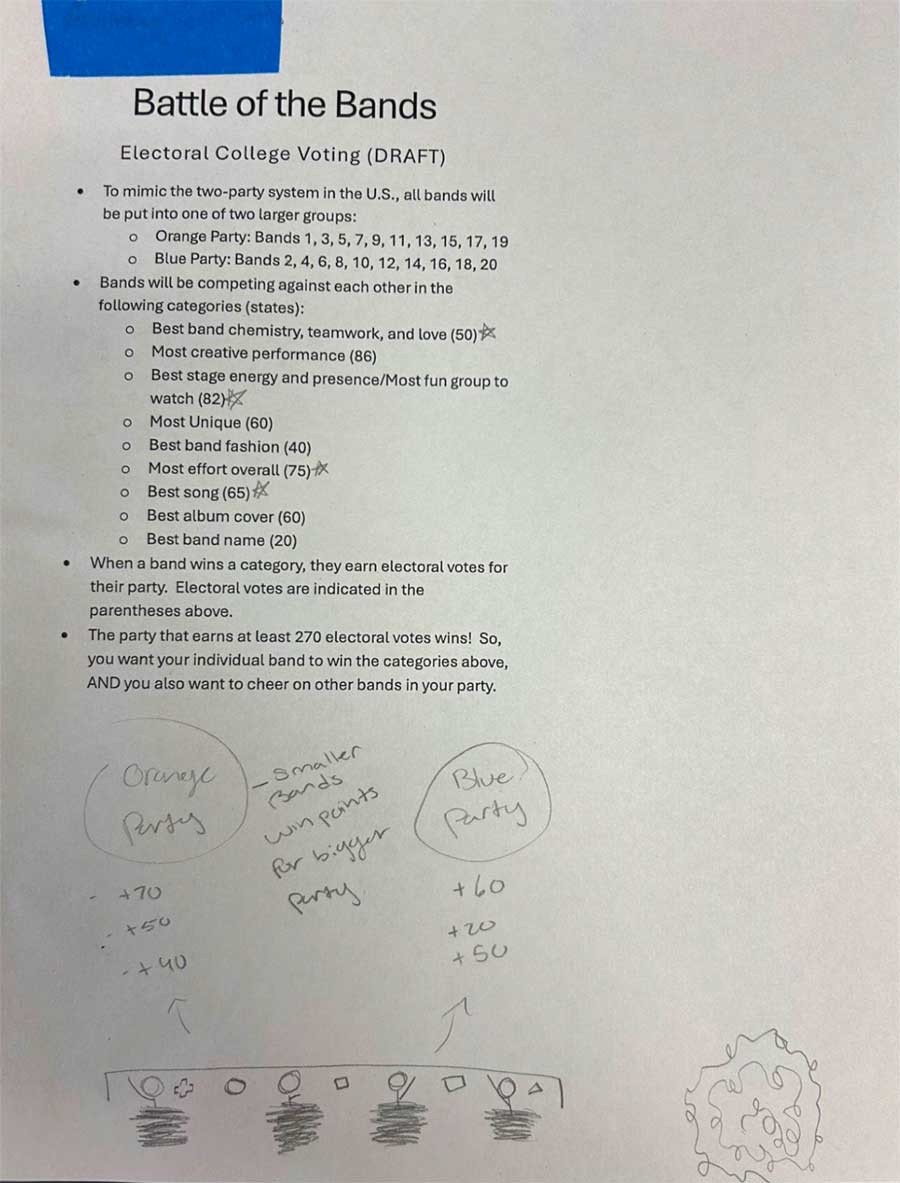
4. Put students into their band groups. Pass out the brainstorming paper asking students to ideate how the Electoral College could be implemented in our Battle of the Band competition. Collect papers. After all groups have brainstormed, synthesize student ideas into a draft to be edited by students tomorrow.

Day 3 (34 minutes)

Daily Goals: Review and edit Battle of the Band Electoral College voting process; Strategize like a presidential candidate to win Battle of the Bands

Bell Ringer: Are you a competitive person? What competitions are important in your community?

Activities:

1. Discuss bell ringer questions in small groups and then have approximately 4 students share out to the whole class. Explain to students that in today’s session we’ll strategize like presidential candidates to win Battle of the Bands.

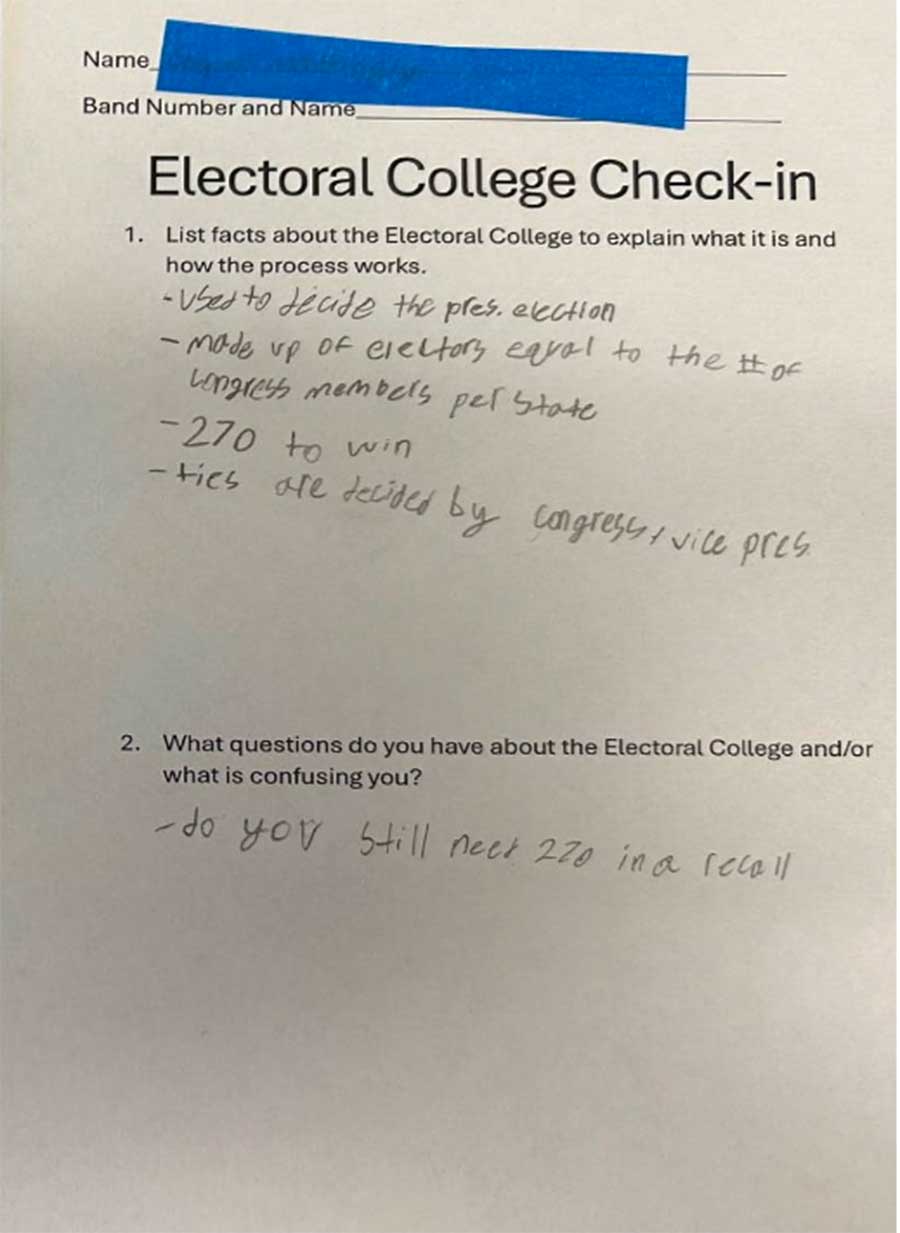
2. Because we were short on time Friday and cut out the Kahoot formative assessment, give students a 2-minute entrance ticket to assess their knowledge of the Electoral College. Clarify any misconceptions and unanswered questions during the class.

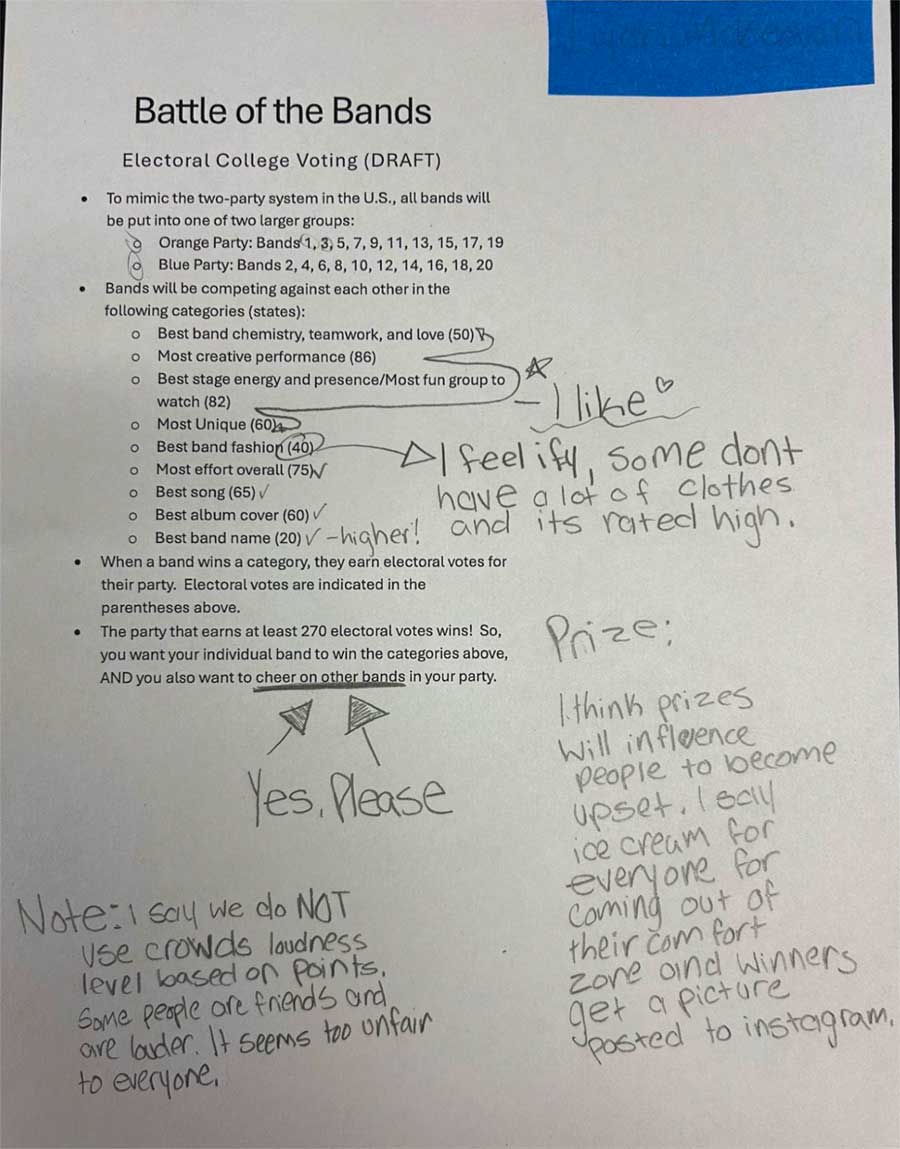
3. Arrange students with their senior/junior partners. Give each pair a draft of the Battle of the Bands Electoral College to critique. Ask students to make notes on their paper for what they like, what needs improvement, and what confuses them. Students can make any additional notes they see fit. Alternatively, pass out a copy of the draft to each student, and read the draft aloud as students annotate with their thoughts and feelings.

4. Have pairs join their larger band groups to share their thoughts and then come together as a whole group to discuss. After all sessions, synthesize student edits into a final Electoral College Battle of the Bands competition. Post the final edit online for all students to see and/or email them.

5. Show students how Harris and Trump are strategizing to win the 2024 election with this video. Discuss the importance of battleground or swing states using 270towin.com. Break down the various strategies Harris and Trump are using to win over voters. As a whole group, brainstorm how we could translate these strategies into our Battle of the Bands competition. Ask students what questions they have.

6. Give students remaining time to strategize what categories in the Battle of the Bands Electoral College are “battleground states” for them. Check in with groups to judge understanding and help strategize.

Demonstration of Learning

Students demonstrate their learning through a series of formative assessments, creation of the Battle of the Bands Ballot (link), their performance on stage in the Battle of the Bands competition (link), and through a post-experience survey reflection (link). The social emotional learning standards are best evaluated through observations during daily lessons, the performance on stage, and in the post-reflection survey. The social studies content standard is best evaluated through the ballot creation process and team strategizing session during Days One and Two.

Final Review

I will know what students have learned through the formative assessments and the student survey.

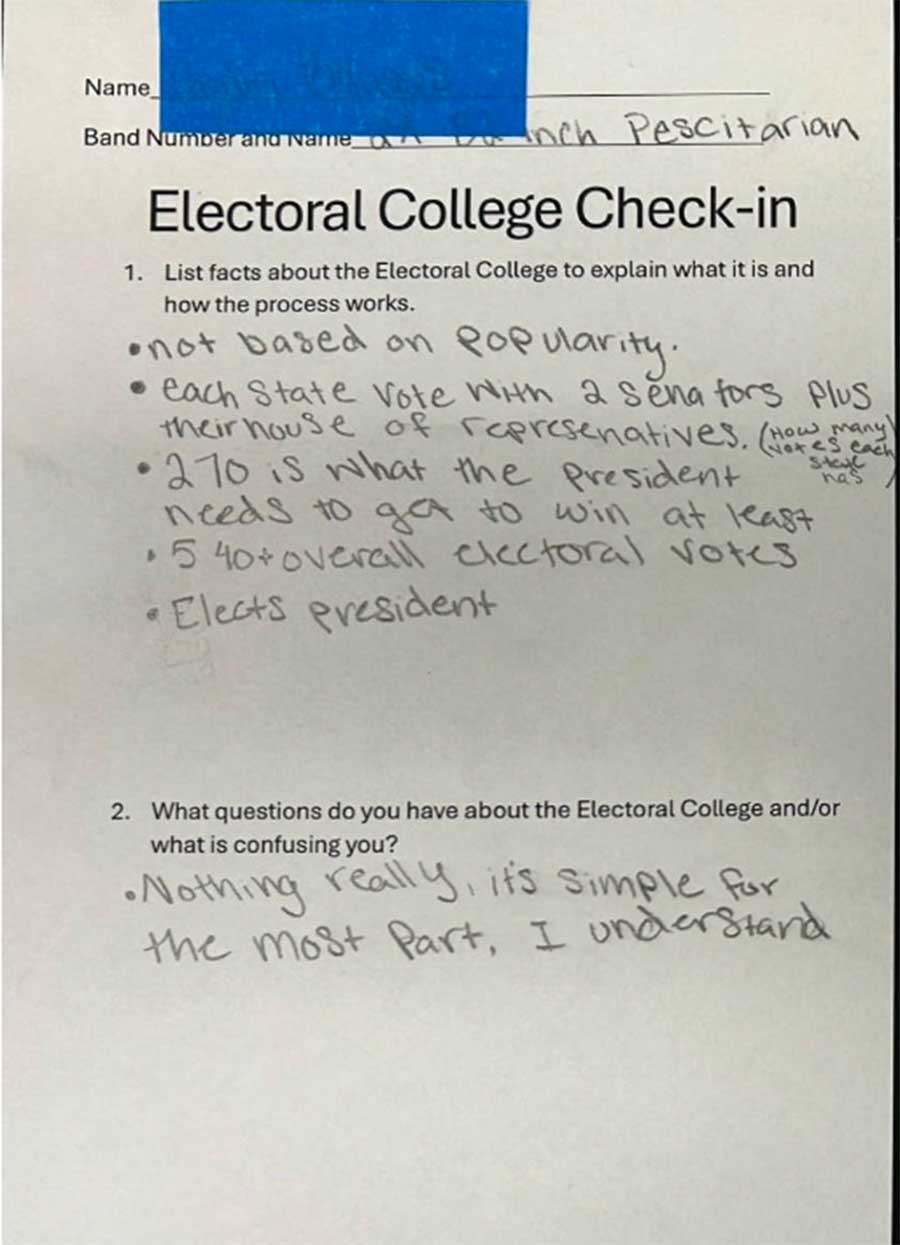
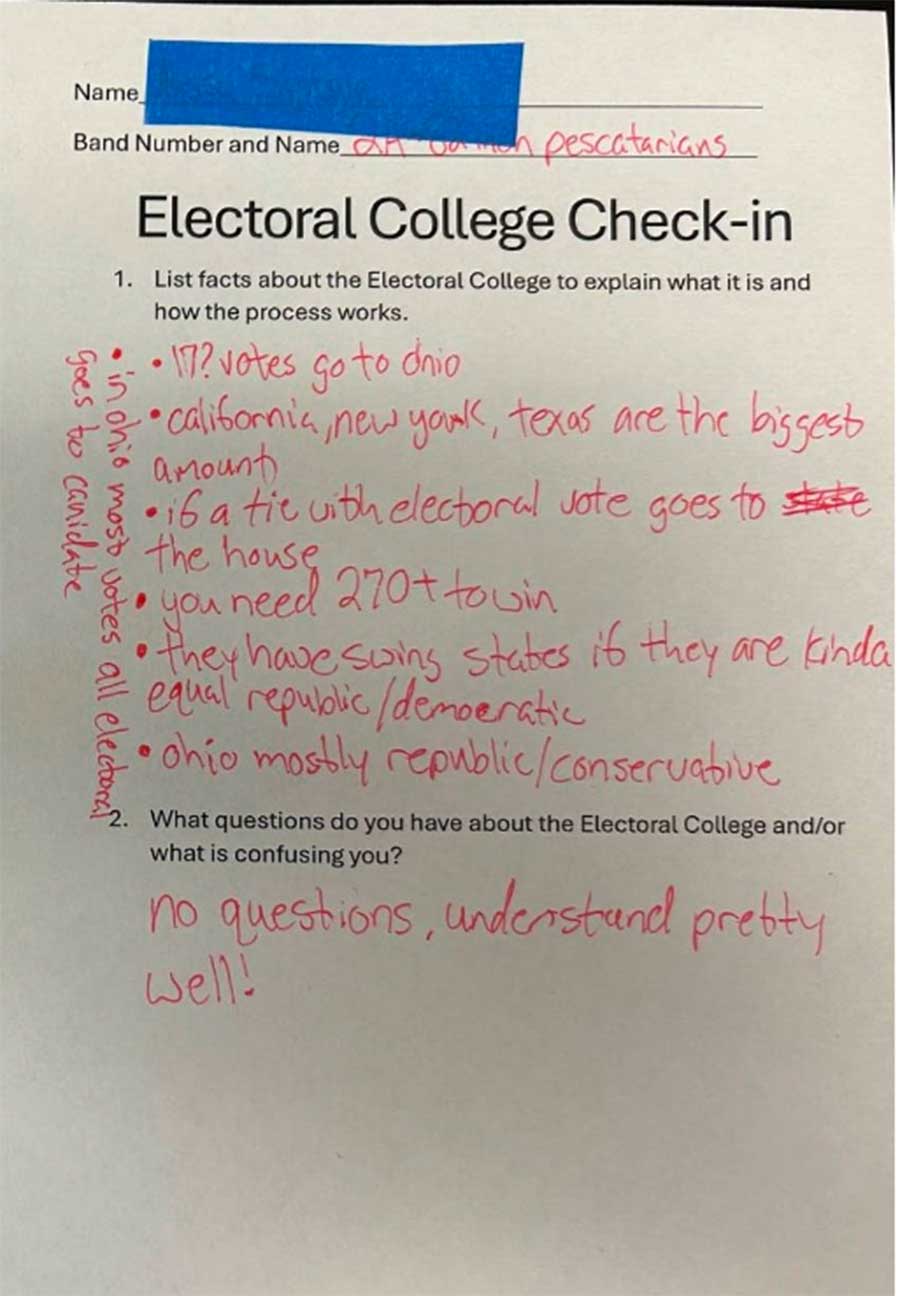
The Kahoot/Electoral College Check-in (depending on which formative assessment is used based on time) will illustrate what critical content information students understand and retain after watching the TedEd video. If students are unsuccessful (less than 70 percent class average on the Kahoot) or many blank/incorrect responses on questions 1 on the Check-in, the lesson must pause, and the Electoral College must be explained in greater detail. Without an understanding of the Electoral College, it’s impossible to build a system of scoring for Battle of the Bands that mimics its format.

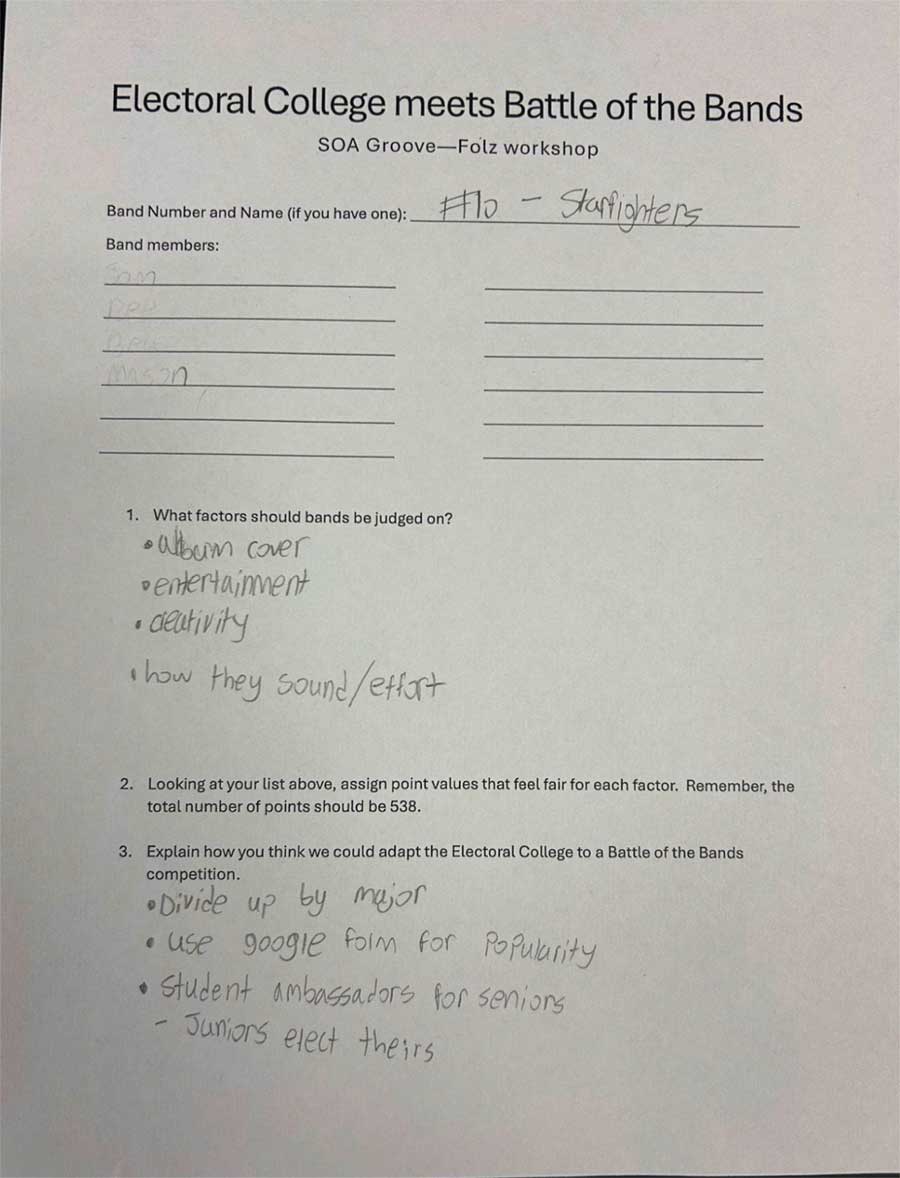
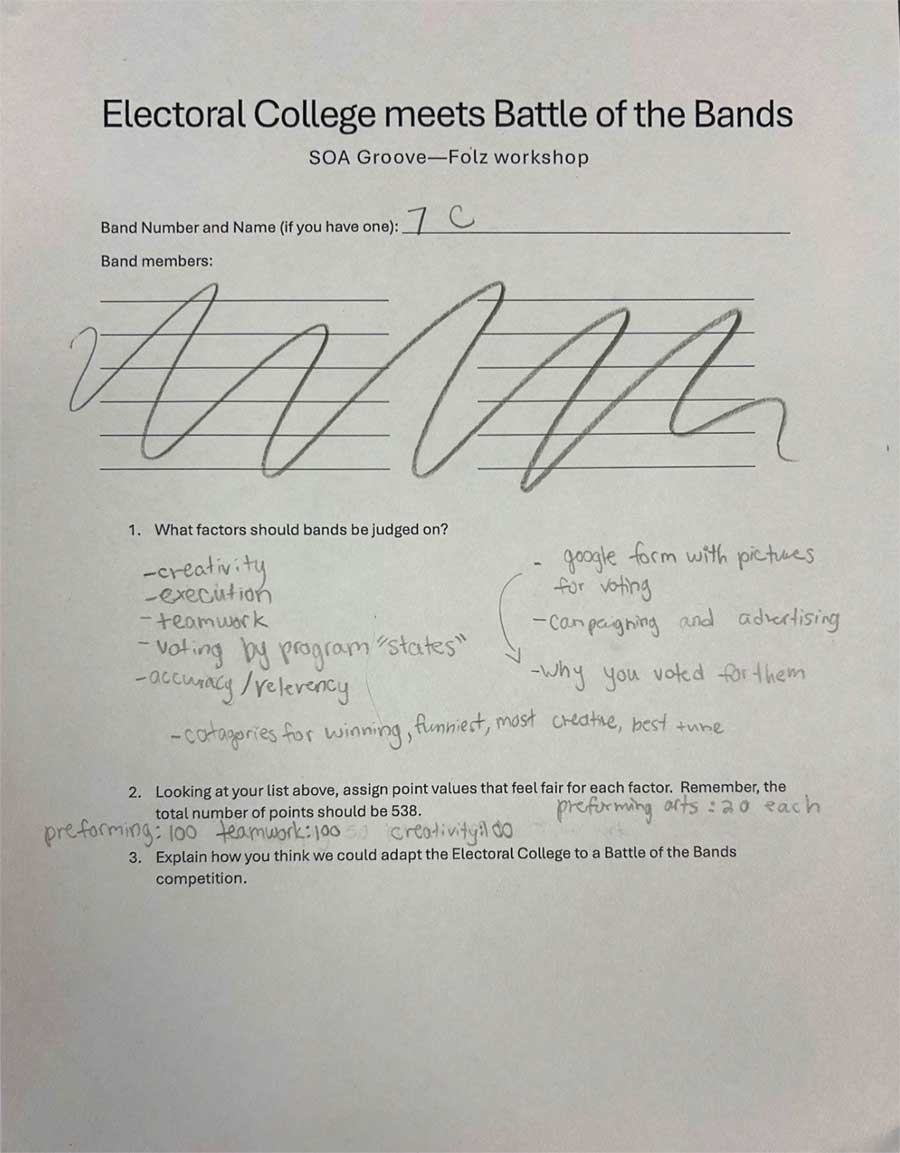
The Electoral College meets The Battle of the Bands workshop/brainstorm paper will give me the biggest insight to the depth of knowledge students have about the Electoral College prior to the student survey. If students can think creatively about how we could create electors, how points should be divided to mimic the electoral count given to each state, I will know they understand major ideas. If they know where and how to problem solve, mastery will be obtained. If students aren’t asking questions like, “How will one band earn 270 points if there are 20 bands? The U.S. has primaries, so will we have something like that?” then they don’t feel motivated and/or this lesson is too high a level given the time constraint. I will need to make modifications and support.

LESSON REFLECTION

Students

After this experience, the entire student body completed an online survey to help shape our school culture and evaluate how well lesson goals were achieved. ChatGPT was used to help analyze the results. Here are the key findings related to this lesson:

Top 5 Points of Clarity Around the Electoral College

1. Understanding the Electoral Vote System:
Many students mentioned that they now have a clearer understanding of how the electoral vote system works, specifically how votes are tallied and how the popular vote within a state translates to electoral votes for candidates. The concept of needing a certain number of votes (e.g., 270) to win was frequently understood.

2. Role of Delegates and Electors:
The process by which delegates or electors are chosen and how they cast their votes was another area of clarity. Students understood that electors typically vote in line with the popular vote in their state, although the system’s nuances still left some with questions.

3. Importance of Swing States:
Students gained a better understanding of why certain states, known as swing states, are critical in the electoral process. The strategic importance of focusing campaign efforts on these states due to their potential to swing the overall election was made clearer.

4. Discrepancy Between Popular Vote and Electoral College:
The distinction between winning the popular vote and winning the Electoral College was clarified for many students. They now understand that a candidate can win the popular vote nationally but still lose the election if they do not secure enough electoral votes.

5. Impact of State Votes:
Students also learned about how the distribution of electoral votes among states affects the overall election. The explanation of why some states have more electoral votes than others, based on population, was a key point of clarity.

Top 5 Areas That Need More Explanation

1. Origin and Purpose of the Electoral College:
Some students expressed confusion about the historical reasons for the creation of the Electoral College and its intended purpose. Understanding the rationale behind why the system was established and how it functions today remains unclear for some.

2. Calculation and Distribution of Electoral Votes:
While students understood that states have different numbers of electoral votes, the exact method of how these numbers are determined and why specific states have more influence was still confusing. The process behind assigning electoral votes based on population or congressional representation needs further explanation.

3. Process and Consequences of a Tie:
The process that occurs in the event of an electoral tie was another area where students felt they needed more clarity. Understanding what happens when no candidate reaches the required 270 electoral votes and how the decision is then made could be better explained.

4. Role and Autonomy of Electors:
Although students grasped that electors typically follow the popular vote, the concept of “faithless electors” or the autonomy electors might have in voting differently than expected was an area of confusion. More information on how often this occurs, and its implications would be beneficial.

5. Connection Between Popular Vote and Electoral Outcomes:
Some students still struggle with the relationship between the popular vote and electoral outcomes, particularly in scenarios where the electoral outcome differs from the popular vote. More detailed explanations on why this discrepancy occurs and its impact on democracy might help solidify understanding.

53% Percent of students rated their understanding of the Electoral College BEFORE the Funk Project at a 4 or 5 (out of 5)

91% Percent of students rated their understanding of the Electoral College AFTER the Funk Project at a 4 or 5 (out of 5)

Teacher

Overall, this lesson was a success at contributing to the larger social emotional goals of my school culture and of building understanding of the Electoral College. In a short amount of time students participated in a very active lesson to develop their understanding of the Electoral College, and most students rated their own understanding higher because of this lesson. Students took their post-experience survey just after voting, and I think some students better understand the Electoral College as winners were announced, and then the overall winner crowned. I am curious if the survey had been administered after the Battle of the Bands competition results were released, if more students would have grasped campaign strategies, and the importance of collecting a wide range of electors to reach 270.

The biggest pivot I would consider moving forward is to provide more structure for students as they brainstorm how the Electoral College could be transformed for a Battle of the Bands judging ballot. Our ballot split student bands into parties to mimic the two-party system in the United States and ensure one party would win, but we missed an opportunity to teach about the significance of primaries. If time allows, it could be neat to have Round 1 and Round 2 for Battle of the bands with primaries. Because many states in the United States require their electors to vote with the popular vote, our electoral votes in the Battle of the Bands competition automatically went to the party that won the popular vote. Still, there is an opportunity here to select student electors, perhaps from each art major.

I would repeat this lesson without hesitation because it gave pride to students, developed social emotional skills by building a community of trust in our building, and created immense motivation to learn more about our government. Although my biggest bummer with the lesson is I just didn’t have time to answer all unique questions about the Electoral College, and that we could have made the Battle of the Bands competition more closely mimic the presidential election process, I know have an entire group of students with some shared background knowledge who are hungry for answers. As we learn more about America’s government and our Constitutional Amendments, I will be able to call back to this lesson and reference it to deepen understanding. All students have this shared experience, providing equity and access. To have that at the start of a school year is a gift!

STUDENT ARTIFACTS