Funky Album Covers: Exploring Identity in Starfish

Developed by Cherie Frantz
Northmont Middle School Dayton, OH

This lesson plan is also available as a printable PDF (link)

Lesson Plan Summary:

From Muse Machine’s 2024 Summer Institute Get in the Groove! Foundations for a Funky Classroom, middle school ELA teacher Cherie Frantz used her experience of creating a funk album cover to inspire her students to do the same, only with the purpose of analyzing characters and character traits from their class novel. In this lesson, students learn how the process of creating artwork enhances one’s ability to better understand a fictional character. This lesson begins with a review of character traits which leads to students realizing that a person – or character – does not have all good or all bad traits. Because the album cover is limited in space, this process requires students to analyze characters more deeply to determine which traits really define the character. Thus, this lesson combines essential ELA standards with valuable lifelong skills and meaning.

Instructor: Cherie Frantz, Northmont Middle School
Title of Lesson: Funky Album Covers: Exploring Identity in Starfish
Date of Implementation: November 2024
Subject Area & Grade Level: ELA 7th Grade
Summer Institute Inspiration: The “funky fundamentals,” album cover art-making activity

LESSON OVERVIEW

Summary:

This lesson reinforces students’ skills in character analysis through the application of “the funky fundamentals”: groove, imagination, identity, and futurism. Students previously read the novel Starfish by Lisa Fipps. Students will now demonstrate their understanding of a character’s background, challenges, and growth throughout the story by creating an album cover for their chosen character and writing an explanation of how their chosen imagery supports their character analysis.

Standards:

RL 7.1 Cite several pieces of textual evidence to support analysis of what the text says explicitly as well as inferences drawn from the text

RL. 7.3 Analyze how particular elements of a story or drama interact (e.g., how setting shapes the characters or plot).

RL.7.6 Analyze how an author uses the point of view to develop and contrast the perspectives of different characters or narrators in a text.

W.7.4 Produce clear and coherent writing in which the development, organization, and style are appropriate to task, purpose, and audience.

Objectives & Outcomes:

Objectives

Students will:

  • Learn four key elements of funk music–groove, imagination, identity, and futurism–and how they can be used to analyze a fictional character.
  • Apply elements of design such as color, shape, and imagery to create a compelling album cover representative of a character.
  • Describe their interpretation of a character through writing, art, and design.

Outcomes

Student can:

  • Gain a deeper understanding of a fictional character’s background, challenges, and growth through the story.
  • Understand how elements of design can work together to form an interpretation of a character’s feelings and mood.
  • Describe and defend their artistic and interpretive choices.
  • Develop empathy for peers and people unlike them by closely studying a fictional character.

Teaching Approaches:

Lecture, small group/individual

Assessment Tools:

Teacher observation, rubric

LESSON PREPARATION

Teacher Needs:

Teacher Context & Research

Watch “Funk: The Sound of Dayton (link),” a student documentary from the University of Dayton, to learn more about the genesis of Dayton’s unique funk sound and cultural impact. One major takeaway is that the genre was developed by young people who were forming their own unique musical identities.

Watch “How the Arts and the Funk Music Influenced My Life (link).”

Given that the Funky Fundamentals – groove, imagination, identity, and futurism – have parallels in the themes of adolescent literature, identify how they connect to character development in the class novel Starfish and how they can be used to analyze characters and character traits.

Helpful Hints

  1. Use the funk songs in the slide presentation or the Muse Institute mixtape to help students get in the groove. Play it at various times in class.
  2. Encourage students to be creative!
  3. Students may think that character traits are solely negative or positive, rather than a mix of both. Discuss this as you model brainstorming character traits on the first day.

Student Needs:

Prior Knowledge

Students read Starfish and gained knowledge about the many characters in the novel. We also discussed bullying and how it affects various people.

Student Voice

Students chose the character they want to highlight on their album. They also chose how to represent the groove, imagination, identity, and futurism of the character on the album cover, the design, the colors, etc.

Vocabulary

  • Groove: The rhythm and flow of the music
  • Imagination: Creativity and innovation in expression
  • Identity: Personal representation and storytelling through art
  • Futurism: Looking forward and envisioning possibilities
  • Symbolism: The use of an object to represent a complex or abstract idea
  • Imagery: Vivid, descriptive language that appeals to the five senses

EVIDENCE OF OUTCOMES

Students will be assessed on their contribution to the discussions of characters, their finished album cover, and their written reflection.

ENDURING UNDERSTANDINGS

We can gain empathy for people by learning what makes them feel creative, which activities and experiences form their core identities, and what hopes and dreams they hold for the future.
Writing and art can be combined to creatively interpret fictional text.

LEARNING PLAN

Essential Questions

How can the fundamentals of funk be used to examine character traits?

How can we really get to know a character in a novel?

Resources

Hook

Students will walk into class with funk music playing in the background. Ask students probing questions, such as “How does this music make you feel?” and “What emotion do you think this person is feeling?”

Main Lesson Narrative/Sequence

Day 1

(Slide 1) Read the first slide about funk music in Dayton. Click the link to watch the first five minutes of “Funk: The Sound of Dayton” University of Dayton student documentary.

(Slides 2-7) Listen to a few funk songs. Introduce the Four Fundamentals of Funk: Groove, Imagination, Identity and Futurism.

(Slide 8) Provide examples of character traits and discuss them as a class. Discuss how these relate to the protagonist, Ellie, and collaboratively brainstorm potential traits, colors, and images that could represent her. Use the funky fundamentals as a tool to brainstorm and as a way of categorizing. (Note: Students may think that character traits are solely negative or positive, rather than a mix of both.)
Ask guiding questions: “What does this character struggle with?” “How does this character change throughout the story?”

(Slide 9) In table groups, students go through other characters in the novel and discuss how the fundamentals of funk fit in with the characters.

Day 2

(Slides 10-13) Students listen to funk music as they look at images of album covers. As a class, discuss what they see and how bands/singers are represented. What makes it memorable? Explain the elements of an album cover: title, artist name, imagery, and symbolism.

(Slides 14-16) Introduce the album cover assignment. Students each choose one character from the novel. Discuss how to choose colors and images that reflect character traits.

Their artwork should include the character’s name, a title, and at least three images or colors that represent key traits. Students will write a short paragraph explaining their choices and how they relate the character’s traits to the four fundamentals of funk.

If students finish early, they should come up with song titles to add to their album.

Demonstration of Learning

Students will share their album covers with their table groups and discuss the character traits they chose to represent. Several students will choose to share their albums with the whole class.

Final Review

The teacher will know from observing the students’ class discussions, completed album covers, and written explanations whether students achieved the desired outcomes as described in the project rubric. Students will be evaluated on their overall creativity; accurate connections to their character; use of funk fundamentals to dig deeper into their character; artistic technique; and ability to write a clear, insightful, and well-articulated explanation.

LESSON REFLECTION

Teacher

Students were more excited about the project than I anticipated. I tried this lesson with all five of my classes, including my two inclusion classes.

I was surprised by some of the students’ responses to music. I had several students dancing, creating beats on the desk, tapping feet or swaying and others that just sat there. Many students didn’t know funk originated in Dayton, Ohio. A few of them did and a few of the students said they had heard some of the songs before because of their parents.

My students were very creative with their albums. Some thought about characters differently than expected. Others didn’t dig very deep into their character and gave surface level details. I am looking at teaching Starfish a little differently next year. I need to have students spend more time on the supporting characters. They could not expand on other characters’ traits in as much detail as the protagonist of the story.

Students (examples)

  • What I learned while working on making an album cover was two main things. One, everyone has their own ideas of what and how to make their own, especially if most people have the same character. Another thing that I learned is really learning the character more and how we get to see that in real life with their favorite hobbies and their personality. This is my personal opinion, but you did a great job with this idea of making an album cover based off a book. It was really fun.
  • I felt a bit nervous about it, but I think it’s good to incorporate creativity outside of writing into subjects.
  • I liked how we got to think about how we wanted our album covers to look.

Student Artifact #1

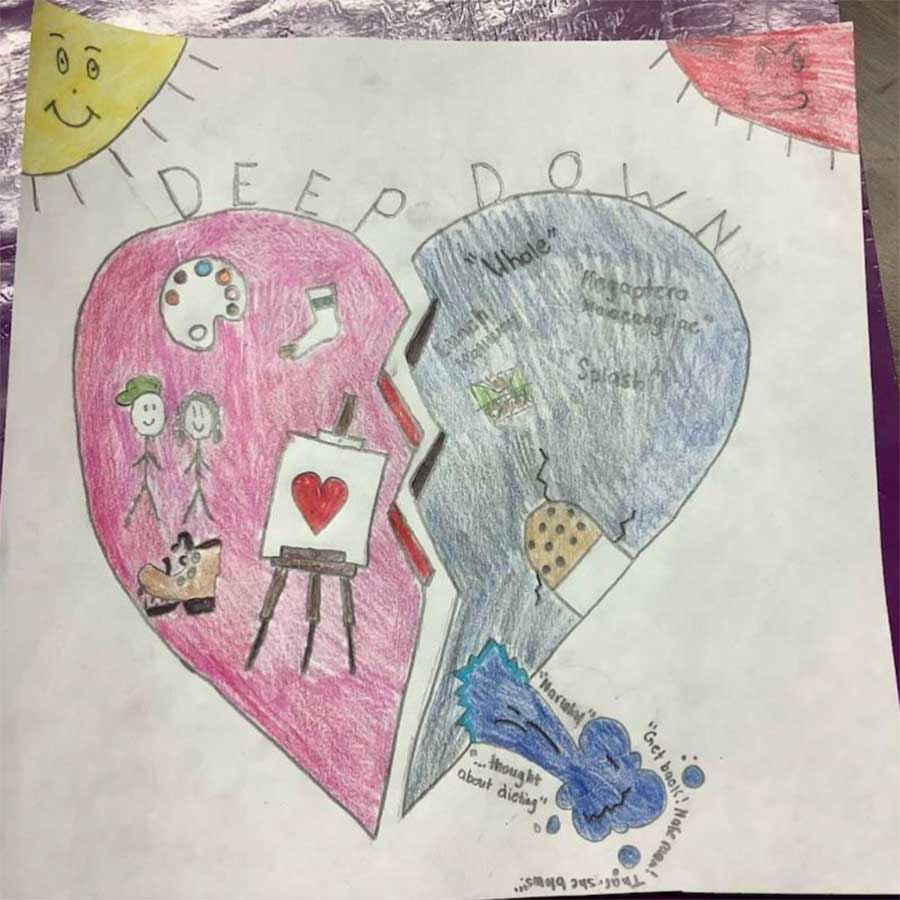
Deep Down

I chose Deep Down because the outside Enemy Number 3 seems like a bully but deep down he’s just going through a hard time. Enemy Number 3 groove is art class. This is because he is a really good artist and mostly enjoys art class. His imagination comes from his artistic abilities. His artwork expresses how he feels deep down. Enemy Number 3 identify is being an artist. Also learning that he can defend himself without hurting others in the making. His futurism is being a professional artist. Also, gaining lots of new friends including Ellie.
Student Artifact #2

The Helping Call

I named it “The Helping Call” because it represents Dr. Woods by her getting a call for help since she is a therapist. The Groove for Dr. Woods is bringing in her dog during the session and bringing in lightsabers, also making assignments to help Ellie get better at defending instead of attacking but also having Ellie tell her mom when she says something that is mean to her. The imagination for Dr. Woods is her critical thinking and making scenarios to explain things to Ellie and also her using lightsabers to teach Ellie to defend herself and not attack. The identity of Dr. Woods is showingprofessionalism because when Ellie sits in Dr. Woods chair Dr. Woods doesn’t let it bother her and just sits on the couch instead. The furturism for Dr. Woods may be Ellie and Dr. Woods don’t have any more appointments because things have got resolved and Ellie has learned everything she needs to know.

Student Artifact #3

Creativity Land


Writing Journal Album Covers

Developed by Brittany Spitnale
David H. Ponitz Career Technology Center Dayton, OH

This lesson plan is available here as a printable PDF

Lesson Plan Summary:

From Muse Machine’s 2024 Summer Institute: Get in the Groove! Foundations for a Funky Classroom, high school ELA teacher Brittany Spitnale uses her experience creating a funk album cover to inspire her students to do the same, only with the purpose of creating a cover for their personal writing journals. In this lesson, students learn how the process of creating artwork enhances one’s ability to interpret and connect with texts. This lesson combines clear standards with valuable lifelong skills and meaning, and teachers may be surprised by the deep thinking generated by this activity. Brittany also learned that her students now value their writing journals because of the personal attachment they feel toward them.

Instructor: Brittany Spitnale, David H. Ponitz Career Tech Center
Title of Lesson: Writing Journal Album Covers
Date of Implementation: September 2024
Subject Area & Grade Level: English Language Arts, 12th grade Summer Institute Inspiration: Album Cover Activity

OVERVIEW OF THE LESSON

Summary:

Students will work on creating a visual text (album cover) to represent their writing. This ties into our development of Reader Response theory for literary analysis and eventually analytical writing. To better understand Reader Response theory, students need a better understanding of 1.) their own identity and 2.) the choices an author makes when composing a text.

Standards:

Ohio Learning Standards: English Language Arts

RL.11-12.10 By the end of grade 12, read and comprehend literature, including stories, dramas, and poems, at the high end of the grades 11–CCR text complexity band independently and proficiently, building background knowledge and activating prior knowledge in order to make personal, societal, and ethical connections that deepen understanding of complex text.

W.11-12.1 Write arguments to support claims in an analysis of substantive topics or texts, using valid reasoning and relevant and sufficient evidence.

Objectives & Outcomes:

Students will be able to better identify their own perspective after stepping into the role of the author and creator of a text. In a future lesson, students will apply this same strategy to creating album art for the poetry of another author instead of themselves using critical lenses.

Teaching Approach(es):

Bell work, writing journals (low-stakes daily writing), brief lecture with models, independent work (“Leave room for the funk!”)

Assessment Tool(s):

● Pre-assessment: Teacher observation of students’ application of OPTIC strategy to commercial album covers

● Formative assessment: Teacher observation of students’ discussion and in-progress work on album covers

● Summative assessment: Rubric for artwork and artist statements

LESSON PREPARATION

Teacher Needs:

Teacher Context & Research

Helpful Hints

  1. Have art supplies prepared and ready before class.
  2. Have students work on identity poetry the day before to help them generate ideas using a “fill-in-the-blank” model for poetry.
  3. Utilize bell work to help students connect the “album art” idea to their own work.

Student Needs:

Prior Knowledge

Students have a basic understanding of reader response theory; however, they are struggling to fully understand how to identify their own biases and opinions while reading, often limiting their commentary to similarities or differences between themselves and the main characters.

Students have been studying vocabulary terms related to poetry and analysis.

In the prior lesson, students composed identity poetry to help them define their sense of self and (unknowingly) generate ideas for this cover. Students may struggle with the belief that they are “not artistic” and may struggle with working inside a time constraint.

Students have also previously been instructed in using the OPTIC strategy for visual texts. The OPTIC strategy has students examine visual texts by looking for Overview, Parts, Text, Interrelations, and Conclusions.

Student Voice

Students have previously expressed an interest in creative projects and working outside of the textbook.

Some students asked about using digital designs on Canva or other visual editing tools.

Student response to the cover art- I have specifically chosen some favorite artists and some that will be unknown.

Vocabulary

Analysis: Detailed examination of the elements or structure of something

Reader Response Criticism: Criticism that focuses on a reader’s active engagement with a piece of print or nonprint text; shaped by the reader’s own experiences, social ethics, moral values, and general views of the world.

Visual text: A non-moving image or picture that conveys meaning

ENDURING UNDERSTANDINGS

Our understanding of texts is shaped by what we bring to them as the reader. As we become more aware of our own biases and opinions, we can engage more deeply with a text and construct meaning that is personally relevant.

Creating our own personally meaningful art and writing helps us to better appreciate other authors’ creative choices.

EVIDENCE OF OUTCOMES

Improvement from pre assessment to post assessment

LEARNING PLAN

Teaching Inquiry Question

How can creating a cover for their writing album help students understand their own identity as a writer?

Essential Question

Who are you?

Resources/Materials

Hook

The hook will be in the form of bell work: “If your life had a soundtrack, what are five songs you would include?”

Main Lesson Narrative/Sequence

Student desks are arranged in small groups. Art supplies are located on a central table, giving students access to a variety of materials for their use.

  1. Per class procedure, students enter the room and retrieve their writing notebooks. Bell work for the day states, “If your life had a soundtrack, what are five songs you would include?” Students write down their five tracks in their writing notebooks.
  2. Introduce the lesson and make connections to prior content knowledge: “Today we’re continuing our work exploring our own identities to help us better understand reader response theory. Yesterday, we worked on identity poetry. Using those ideas, or any others you have about yourself, you will create a cover for your writing notebook. Think of this as your album: your collection of writing. If your work were an album, what would the cover art look like? Cover art is created by an artist- an author of the visual text. Just like we practiced reading advertisements, cover art can be read much the same way – and we can still use the OPTIC strategy. Let’s look at a few examples.”
  3. Go through the cover art slides, letting students respond to the artwork. Share a few historical/cultural notes on each after they have the initial response. (Slides are intentionally left blank other than the artwork and citation.)
  4. Students will create a 6”x6” square album cover of their own design. Provide art supplies and laptops. Digital art MUST be submitted as a 6”x6” PDF on Google Classroom. This cover will later be laminated and attached to the front of their writing notebooks as the “album cover” of their own written art.
  5. Circulate while assisting and encouraging students as they work. Ask thoughtful open- ended questions when students are struggling (“What color-scheme best represents you?” “What font/lettering style do you intend to use?” “What text, if any, are you including?”) Students will be more successful if they select ONE aspect of themselves to represent instead of trying to include many ideas.
  6. When finished, students will also include an Artist Statement written in the third person. A complete statement will include who they are, a description of what they created, and why they feel the artwork represents them.

Demonstration of Learning

Student created album cover with artist statement

Final Review

I will know that students have formed a clearer understanding of themselves and their own identity as they are able to create their cover and can explain its significance as the author. Students will continue to practice reader response theory on upcoming assignments. I anticipate seeing a clearer understanding of the interaction between the reader, the situation, and the text in upcoming assignments after this lesson, once the reader is more clearly defined. I also anticipate that students will demonstrate deeper analysis in this unit’s final analysis essay.

LESSON REFLECTION

Students

Students enjoyed the activity and have taken pride in their bell work journals.

Teacher

I was hopeful that students would further understand their role in creating meaning from text. After this activity, we revisited the Reader Response to poetry. Student answers showed improvement after spending time examining themselves and the decision-making process authors/artists make as they work to generate their own image. Students also were able to demonstrate competence with the OPTIC strategy.

What I did not expect was that students took such extreme pride in their work, showing it off to classmates, discussing their art independently, and writing about it during that week’s Freewrite Friday. Students have asked to do more projects like this one in the future.

STUDENT ARTIFACTS

Final copies of album art, laminated and added to covers of writing journals

See student examples here (link)

Orchestra Schedule

Schedule is subject to change. Changes to the original schedule appear in green.

November

SAT, NOV 9

No rehearsal
This morning is the Advance Ticket Sale for families of cast, orchestra and PAs. Find complete details here

MON, NOV 18

4:30-7:00pm
Muse Machine: Metropolitan Arts Center, Third Floor, 126 N Main St (next to the Victoria Theatre)

THURS, NOV 21

4:30-7:00pm
Muse Machine, Third Floor

December

SAT, DEC 7

10:00am-12:30pm
Muse Machine, Third Floor

SAT, DEC 14

10:00am-12:30pm
Muse Machine, Fourth Floor

SUN, DEC 15

11:30am-4:00pm
Muse Machine, Fourth Floor – Sitzprobe
The Winter Party & Dance for cast, orchestra and PAs is this evening from 6-9pm at the Packard Museum. Find more info here.

MON, DEC 16

4:30-8:30pm
Muse Machine, Fourth Floor – Rehearsal with cast

January

SAT, JAN 4

10:00am-12:30pm
Muse Machine, Second Floor – Orchestra rehearsal

THURS, JAN 9

5:00-9:00pm
Victoria Theatre – Tentative Victoria Theatre load-in/rehearsal

FRI, JAN 10

5:00-9:00pm
Victoria Theatre – Tentative Victoria Theatre load-in/rehearsal

SAT, JAN 11

5:00-9:00pm
Victoria Theatre – Rehearse with cast

SUN, JAN 12

5:00-9:00pm
Victoria Theatre – Rehearse with cast

TUES, JAN 14

5:00-9:00pm
Victoria Theatre – Rehearse with cast

WED, JAN 15

5:00-9:00pm
Victoria Theatre – Rehearse with cast

THURS, JAN 16

6:30pm
PERFORMANCE: Victoria Theatre – 6:30 call; 7:00 curtain (run time approx 2.5 hours)

FRI, JAN 17

7:00pm
PERFORMANCE: Victoria Theatre – 7:00 call; 7:30 curtain (run time approx 2.5 hours)

SAT, JAN 18

2:30pm
PERFORMANCE 1: Victoria Theatre – 2:00 call; 2:30 curtain (run time approx 2.5 hours)
Meal served on MAC fourth floor between performances
PERFORMANCE 2: Victoria Theatre – 7:00 call; 7:30 curtain (run time approx 2.5 hours)

SUN, JAN 19

1:30pm
PERFORMANCE: Victoria Theatre – 1:30 call; 2:00 curtain (run time approx 2.5 hours)

Rehearsal Schedule Cats

How to Read This Schedule

• You received a casting letter with a list of songs – every list is specific to that person. Each segment of a rehearsal includes a list of people who attend in parentheses. If your letter lists Macavity The Mystery Cat and you see:

WED, NOV 20
4:30-8:30
Macavity The Mystery Cat
(Mac, Bomba, Demeter, Deut, Macavity The Mystery Cat performers)

… then you would attend that rehearsal because Macavity The Mystery Cat performers is listed in parentheses. You are matching the info in your letter to the parentheses lists in the schedule. Look carefully – some of the songs in this show have similar names!

• A handful of performers have a specific role/character name on their letter as well. Those performers will also attend when those characters are listed by name on the schedule (so you are looking for the songs on your letter and/or your character name in the schedule). Principals and understudies always attend when that character is listed.

• Sometimes actors are indicated on the schedule by their real names. Of course, you should attend if you are named in a rehearsal.

• The word “tutti” refers to the entire “older” company (but not the Young Cast). If it says tutti, you should attend.

• What if the schedule says that a song is being rehearsed that is on your casting letter, but the list of needed performers in parentheses doesn’t include you? That simply means that we aren’t using everyone on that particular day and you don’t need to attend.

Please Note

• It may be convenient to bookmark musemachine.com/backstage on your device. Tapping a month’s name on the right will auto-scroll you to that month. Remember that updates to the online schedule will occur throughout the rehearsal period, so if you print the schedule, it will become outdated.

• When updates are made to this schedule, you will be notified via voice message, the change will initially appear at the top of the Backstage page and the changes will also appear in green on this schedule. Currently, notes of interest appear in red.

• This schedule is for grades 8-12 (the “Cast”). Although there is some overlap, the younger performers (grades 2-7) have a separate schedule for “Young Cast”.

• “AIS2” means Act One, Scene Two; “AIIS3” means Act Two, Scene Three, and so on.

• Song titles appear in italic type.

• On several days throughout the rehearsal period, we will be “dark” – meaning no rehearsal. There are also breaks for Thanksgiving and in late December for the winter holidays.

• If a day simply indicates “Rehearsal” without specifying a scene or song, this indicates a complete run-through of the show (these begin in December).

• For speaking characters, be very familiar with your scene/lyrics the first time it is rehearsed. The second time any scene appears on the schedule, you should be essentially off-book (memorized) for that scene.

October

SAT, OCT 19

Vocal music sessions for selected characters/understudies

10:00-11:30
Dance class
(Tutti)
“Tutti” means the entire older cast
11:30-12:30
The Naming Of Cats
(Tutti)

The remainder of the day is vocal music appointments for selected characters, including understudies:

12:30-1:30  Munkustrap (abbreviated Munk)
1:30-2:15  Tugger
2:30-3:15  Skimbleshanks (abbreviated Skimble)
3:15-3:45  Pouncival (abbreviated Pounce)
3:45-4:15  Gus & Jellylorum (abbreviated Jelly)
4:15-5:15  Bombalurina (abbreviated Bomba), Demeter and Jelly
5:15-6:00  Bomba & Demeter

SUN, OCT 20

1:00-2:30
Dance class
(Tutti)
2:30-4:00
Costume fittings
(Tutti)

The remainder of the day is vocal music appointments for selected characters, including understudies. Those with vocal appointments should stop in for costume measurements when they are not singing.

2:30-3:00  Sillabub (abbreviated Sill)
3:00-3:30 Jennyanydots (abbreviated Jenny)
3:30-4:30  Mungojerrie (abbreviated Mungo) and Rumpleteaser (abbreviated Rumple)
4:30-5:30  Deuteronomy (abbreviated Deut)

MON, OCT 21

4:30-6:00
Dance class
(Tutti)
6:00-8:00
Mungojerrie And Rumpleteaser
(Mungo, Rumple)

TUES, OCT 22

4:30-5:30
Dance class
(Tutti)
5:30-6:00
Vocal class
(Tutti)
6:00-8:00
Mungojerrie And Rumpleteaser
(Mungo, Rumple)

WED, OCT 23

4:30-5:30
Dance class
(Tutti)
5:30-6:00
Vocal class
(Tutti)
6:00-8:00
Mungojerrie And Rumpleteaser
(Mungo, Rumple)

THURS, OCT 24

4:30-6:00
Dance class
(Tutti)

FRI, OCT 25

4:30-7:30
Vocal rehearsal and initial staging of Grizabella’s songs
(Grizabella [abbreviated Griz])

SAT, OCT 26

10:00-11:30
Dance class
(Tutti)
11:30-12:30
Vocal class
(Tutti)
12:30-1:30
Mungojerrie And Rumpleteaser
(Mungo, Rumple)

SUN, OCT 27

1:00-2:30
Dance class
(Tutti)
2:30-3:30
Vocal class
(Tutti)
3:30-4:30
Review of Grizabella’s material
(Griz)

MON, OCT 28

4:30-5:30
Dance class
(Tutti)
5:30-6:30
Jellicle Songs For Jellicle Cats vocals
(Bomba, Demeter, Deut, Griz, Gus, Jelly, Jenny, Macavity [abbreviated Mac], Mistoffolees [abbreviated Mist], Mungo, Munk, Pounce, Rumple, Sill, Skimble, Tugger, Victoria)
6:30-8:30
Jellicle Songs For Jellicle Cats choreography
(Same group from 5:30)

TUES, OCT 29

4:30-5:30
Dance class
(Tutti)
5:30-6:15
Jellicle Songs For Jellicle Cats vocals
(Bomba, Demeter, Deut, Griz, Gus, Jelly, Jenny, Mac, Mist, Mungo, Munk, Pounce, Rumple, Sill, Skimble, Tugger, Victoria)
6:15-8:30
Jellicle Songs For Jellicle Cats choreography
(Same group from 5:30 PLUS: AJ H, Alaina H, Amee H, Brooke K, David H, Kara S, Keegan R, Kennedy J, Leonardo P, Molly W, Teigan J, Vanessa H – This larger group also attends all future rehearsals for Jellicale Songs For Jellicle Cats)

WED, OCT 30

4:30-5:30
Dance class
(Tutti)
5:30-6:30
The Naming Of Cats vocals
(Tutti)
6:30-8:30
The Naming Of Cats staging
(Tutti)

THURS, OCT 31

Dark
In the performing arts, “dark” means no rehearsal or performance.
Happy Halloween!

November

FRI, NOV 1

When you see multiple rehearsals happening at the same time, that means we will have simultaneous rehearsals in different studio spaces in our building…

3:30-4:30
Victoria’s Dance

(Victoria)
4:30-6:30
Gus The Theatre Cat
(Gus, Jelly)
6:30-8:30
Old Deuteronomy
(Munk, Tugger, Skimble, Deut)
6:30-8:30
Macavity The Mystery Cat early movement work
(Bomba, Demeter)

SAT, NOV 2

10:00-12:30
Review completed material
(Tutti)
12:30-1:30
Lunch
1:30-3:00
Jellicle Ball
(Tutti minus Griz)
3:00-5:00
Jellicle Songs for Jellicle Cats
(Bomba, Demeter, Deut, Griz, Gus, Jelly, Jenny, Mac, Mist, Mungo, Munk, Pounce, Rumple, Sill, Skimble, Tugger, Victoria, AJ H, Alaina H, Amee H, Avery E, Brooke K, David H, Kara S, Keegan R, Kennedy J, Leonardo P, Teigan J, Vanessa H)

SUN, NOV 3

1:00-2:00
Vocal class
(Tutti)
2:00-3:00
Dance class
(Tutti)
3:00-5:00
Jellicle Ball
(Tutti minus Griz)
Remember to set any non-automated clocks back this morning!

MON, NOV 4

4:30-5:00
Dance class
(Tutti minus Griz)
5:00-8:30
Jellicle Ball
(Tutti minus Griz)

TUES, NOV 5

Dark
Election Day

WED, NOV 6

4:30-6:30
The Awefull Battle Of The Pekes And The Pollicles
(Munk)
6:30-8:30
Skimbleshanks The Railway Cat vocals & staging
(Skimble, Skimbleshanks The Railway Cat performers)
6:30-8:00
Invitation To The Jellicle Ball movement work
(Victoria, Mist)

THURS, NOV 7

4:30-6:00
The Awefull Battle Of The Pekes And The Pollicles
(Munk)
6:00-8:30
Skimbleshanks The Railway Cat
(Skimble, Skimbleshanks The Railway Cat performers)
6:00-8:00
Macavity The Mystery Cat movement work
(Bomba, Demeter)

FRI, NOV 8

4:30-8:30
Selected new material
(All principal performers and understudy performers)

SAT, NOV 9

This morning is the Advance Ticket Sale for families of cast, orchestra and PAs. Find complete details here.

This day is also the first beverage drop off. Please bring two cases of water, soda or sports drink and a volunteer will collect the beverages from your car. Beverages will be used for upcoming student meals — thank you!

9:30-10:00
Dance class 
(Tutti)
10:00-12:30
Review completed material & learn Rum Tum Tugger vocals
(Tutti)
12:30-1:30
Lunch
1:30-4:00
Rum Tum Tugger early movement work
(Tugger)
1:30-4:00
Skimbleshanks The Railway Cat
(Skimble, Skimbleshanks The Railway Cat performers)

SUN, NOV 10

11:30-1:00
Magical Mister Mistoffelees early movement work
(Mist)
1:00-2:30
Rum Tum Tugger choreography
(All male-identifying performers)
1:45-2:30
Selected Rum Tum Tugger choreography
(Add following performers Addison H, Amari B, Amee H, Aurora C, Grace M, Kara S, Kelsie D, Liliane K, Morgan E, Vanessa H, Via M)
1:00-2:30
Selected song and staging review
(Bomba, Demeter, Griz, Jelly, Sill)
2:30-5:00
Rum Tum Tugger choreography
(Tutti minus Griz)

MON, NOV 11

4:30-6:00
Rum Tum Tugger
(All male-identifying performers)
6:00-8:30
Rum Tum Tugger
(Tutti minus Griz)

TUES, NOV 12

4:30-5:30
Gumbie trio choreography
(Bomba, Demeter, Jelly)
5:30-8:30
The Old Gumbie Cat
(Munk, Jenny, Bomba, Demeter, Jelly)

WED, NOV 13

4:30-6:00
The Awefull Battle Of The Pekes And The Pollicles
(Munk, Vocal Ensemble 1 – this includes Alaina H, David H, Faye Y, Graysen T, Josiah W, Nate B, Ruth D, Via M)
6:00-8:30
The Old Gumbie Cat
(Munk, Jenny, Bomba, Demeter, Jelly, Old Gumbie Cat performers)

THURS, NOV 14

4:30-6:00
The Awefull Battle Of The Pekes And The Pollicles
(Munk, Vocal Ensemble 1 – this includes Alaina H, David H, Faye Y, Graysen T, Josiah W, Nate B, Ruth D, Via M)
6:00-8:30
The Old Gumbie Cat
(Munk, Jenny, Bomba, Demeter, Jelly, Old Gumbie Cat performers)

FRI, NOV 15

Dark

SAT, NOV 16

10:00-11:30
Entry Of Grizabella
(Griz, Bomba, Demeter, Vocal Ensemble 1 – this includes Alaina H, David H, Faye Y, Graysen T, Josiah W, Nate B, Ruth D, Via M)
11:30-1:00
Rehearse completed material
(Tutti)
1:00-2:00
Lunch
2:00-5:00
Rehearse completed material and Journey To The Heaviside Layer vocals
(Tutti)

SUN, NOV 17

1:00-5:00
Magical Mister Mistoffelees
(Tutti minus Griz)

MON, NOV 18

4:30-8:30
Magical Mister Mistoffelees
(Tutti minus Griz)

TUES, NOV 19

4:30-5:00
Dance class
5:00-8:30

Dance review, incl Jellicle Songs For Jellicle Cats, Invitation To The Jellicle Ball, Rum Tum Tugger, The Song Of The Jellicles, The Jellicle Ball, The Gumbie Cat (dance break), Magical Mister Mistoffelees (dance only)
(Tutti minus Griz)

WED, NOV 20

4:30-6:30
(Bomba & Demeter only)

6:308:30

Macavity The Mystery Cat
(Mac, Bomba, Demeter, Deut, Macavity The Mystery Cat performers; Deut is not required)

THURS, NOV 21

4:30-7:00
Macavity The Mystery Cat
(Mac, Bomba, Demeter, Deut, Macavity The Mystery Cat performers)
Rehearsal will end at 7:00pm

FRI, NOV 22

Dark

SAT, NOV 23

10:00-noon
The Awefull Battle Of The Pekes And The Pollicles
(Munk, Vocal Ensemble 1 – this includes Alaina H, David H, Faye Y, Graysen T, Josiah W, Nate B, Ruth D, Via M)
noon-1:00
Lunch
1:00-1:30 
Dance class
(Tutti)
1:30-5:00
Complete necessary staging and transitions
(Tutti)

SUN, NOV 24

noon-2:00
Entry Of Grizabella, Grizabella The Glamour Cat/Memory 1
(All performers from Invitation To The Jellicle Ball; Griz does attend; Deut does not attend)
2:00-3:00
Review and complete transitions
(Tutti)
3:00-5:00
Preview Performance assembly and rehearsal
(Tutti)

MON, NOV 25

4:30-5:00
Dance class
(Tutti)
5:00-8:30
Rehearsal
(Tutti)
Happy birthday, Joe Deer!

TUES, NOV 26

4:30-7:30
Journey To The Heaviside Layer & The Ad-Dressing Of Cats
(Tutti)
7:30-8:30
Preview Performance rehearsal
(Tutti)

WED, NOV 27–SUN, DEC 1

Thanksgiving Break
Happy Thanksgiving!

December

MON, DEC 2

4:30-8:30
Review of selected production numbers & Preview Performance rehearsal
(Tutti)

TUES, DEC 3

4:30-8:30
Curtain call,  Finale & Preview Performance rehearsal
(Tutti)

WED, DEC 4

4:30-6:00
The Awefull Battle Of The Pekes And The Pollicles
(Munk, Vocal Ensemble 1 – this includes Alaina H, David H, Faye Y, Graysen T, Josiah W, Nate B, Ruth D, Via M)
6:00-8:30
Preview Performance rehearsal
(Tutti)

THURS, DEC 5

4:30-6:30
Preview Performance rehearsal and various review
(Tutti)
6:30-7:30
Preview Performance
Rehearsal ends at 7:30. For what to wear to preview performance, click here. 

FRI, DEC 6

Dark

SAT, DEC 7

1:00-1:30
Dance class
(Tutti)
1:30-6:00

Rehearsal
(Tutti)
Please note the different beginning and ending times on this Saturday.

SUN, DEC 8

1:00-6:00
Production number rehearsal
(Tutti)
Please note the different ending time on this Sunday.

MON, DEC 9

4:30-8:30
Rehearsal
(Tutti)

TUES, DEC 10

4:30-8:30
Rehearsal – understudy focus
(Tutti)

WED, DEC 11

4:30-8:30
Act One
(Tutti)

THURS, DEC 12

4:30-8:30
Act Two
(Tutti)

FRI, DEC 13

Dark

SAT, DEC 14

1:00-1:30
Dance class
(Tutti)
1:30-6:00

Rehearsal
(Tutti)
Please note the different beginning and ending times on this Saturday

SUN, DEC 15

noon-3:00
Sitzprobe
(Tutti)
3:00-4:00
Sitzprobe
(Only performers in the following songs need to remain until 4:00: Jellicle Songs for Jellicle Cats, Victoria Solo, The Invitation to the Jellicle Ball, Entry of Grizabella, The Old Gumbie Cat, Mungojerrie and Rumpleteazer, Grizabella the Glamour Cat/Memory 1, Introduction to the Jellicle Ball,
Introduction to Act II/Memory 2, Gus the Theatre Cat, The Aweful Battle of the Pekes and the Pollicles)

Please note different beginning and ending times on this day.

The Sitzprobe is a concert version of the musical numbers from the show combining the cast and orchestra.

This day is the second beverage drop off. Please bring two cases of water, soda or sports drink and when you drop your student outside the Muse building, a volunteer will collect the beverages from your car. Beverages will be used for upcoming student meals — thank you!

Parents who are bringing food for the Winter Party & Dance may also drop the food curbside prior to rehearsal when they drop off students, at the same time as the beverage drop. 

The Winter Party & Dance is this evening from 6-9pm at the Packard Museum. Find more info here.

MON, DEC 16

4:30-8:30
Rehearsal with orchestra and staging
(Tutti)

TUES, DEC 17

4:30-8:30
Act One
(Tutti)

WED, DEC 18

4:30-6:00
The Aweful Battle Of The Pekes And The Pollicles
(Munk, Vocal Ensemble 1 – this includes Alaina H, David H, Faye Y, Graysen T, Josiah W, Nate B, Ruth D, Via M)
6:00-8:30
Act Two
(Tutti)

THURS, DEC 19

4:30-8:30
Rehearsal
(Tutti)

FRI, DEC 20—WED, JAN 1

Winter Break
Merry Christmas!
Happy Hanukkah!

Happy Kwanzaa!
Happy New Year!

January

THURS, JAN 2

4:30-8:30
Rehearsal
(Tutti)

FRI, JAN 3

4:30-8:30
Rehearsal
(Tutti)

SAT, JAN 4

10:00-noon
The Awefull Battle Of The Pekes And The Pollicles
(Munk, Vocal Ensemble 1 – this includes Abriella, Alaina H, David H, Emerson, Faye Y, Gavin P, Graysen T, Hayley C, Houda, Josiah W, Lucas, Nate B, Parker, Ruth D, Via M)
noon-1:00
Lunch
1:00-5:00
Rehearsal
(Tutti)

SUN, JAN 5

1:00-5:00
Rehearsal – understudy focus
(Tutti)

MON, JAN 6

Dark 

Understudy Performance rescheduled to Jan 7 due to weather.

TUES, JAN 7

4:30-5:30
Rehearsal
(Tutti)
5:30-8:30
Understudy Performance
(Tutti)

This is the tentative Understudy Performance. Families of the understudy cast are invited to attend via RSVP at musemachine.com/backstage (RSVP link online in Dec). Non-flash photos are welcomed (no video).

WED, JAN 8

4:30-8:30
Rehearsal
(Tutti)

THURS, JAN 9

4:30-10:00
Rehearsal: primarily Act One spacing
(Tutti)
• Most remaining rehearsals are held at the Victoria Theatre.
• On this day, come to the Muse studio first.
• You will always leave at the end of the night from the Muse studio (even when we rehearse at the Victoria).
• Do not bring anything that isn’t absolutely necessary to the remaining rehearsals. Items forgotten in the Victoria Theatre cannot be retrieved until the next day (including car keys, school work, etc).
• Only water is permitted in the theatre (no other beverages). You may leave snacks (w your name) in a specific area adjacent to the theatre. Bring items that don’t require refrigeration or heat.

FRI, JAN 10

5:00-10:00
Rehearsal: primarily Act Two spacing
(Tutti)
Report directly to the Victoria Theatre. When reporting to the Victoria, always arrive 15-20 minutes before the beginning of rehearsal (not earlier or later). If you need to arrive earlier, go to the Muse studio first.

SAT, JAN 11

Noon10:00pm
Tech Rehearsal (Act One x2) with costumes and make-up
(Older cast)
Dinner provided between rehearsals, 4:00-5:00.

SUN, JAN 12

Noon-10:00pm
Tech Rehearsal (Act Two x2) with costumes and make-up
(Older cast)
Dinner provided between rehearsals, 4:00-5:00.

MON, JAN 13

No rehearsal.

TUES, JAN 14

5:00-10:00
Rehearsal with tech, costumes and make-up
(Older cast)

WED, JAN 15

5:00-10:00
Rehearsal with tech, costumes and make-up
(Older cast)

THURS, JAN 16

Performance (Opening Night)
5:30: Dance warmup in Muse studio
6:00:Get into costumes and makeup at Victoria Theatre
6:45: Vocal warmup on stage
7:00: Curtain (“Curtain” is the time the performance begins)
10:30: Cast released (approx)

FRI, JAN 17

Performance
6:00: Dance warmup in Muse studio
6:30:Get into costumes and makeup at Victoria Theatre
7:15: Vocal warmup on stage
7:30: Curtain
10:30: Cast released (release time is now earlier!)
Please note that the Friday performance time is earlier than previous years.

SAT, JAN 18

Two performances
1:00: Dance warmup in Muse studio
1:30:Get into costumes and makeup at Victoria Theatre
2:15: Vocal warmup on stage
2:30: Curtain
*Dinner provided between performances
6:30: Get into costumes and makeup at Victoria Theatre
7:15: Vocal warmup on stage
7:30: Curtain
10:30: Cast released (release time is now earlier!)
Please note that both of  the Saturday performance times are earlier than previous years.

SUN, JAN 19

Performance (Closing Performance)
12:30: Dance warmup in Muse studio
1:00: Get into costumes and makeup at Victoria Theatre
1:45: Vocal warmup on stage
2:00: Curtain
5:00: Cast released (release time is now earlier!)

6th Grade Meets Jim Henson’s Muppets

Muse Machine 2023 Advanced Teacher Training Seminar-Inspired Lesson Plan
Developed by Amy Mullins
Edwin D. Smith School, Dayton, OH
Art
Grade Level: 6

This lesson plan is also available as a printable PDF:

View Lesson Plan PDF

Introduction:

As creative as art teachers are, most will admit the difficulty of continuously bringing new ideas to their classroom. Amy Mullins of Smith Elementary found her inspiration during the 2023 Advanced Teacher Training Seminar during a discussion with Alan Muraoka, veteran actor, writer and director on Sesame Street, and through a visit to the Museum of the Moving Image. She used that inspiration to challenge her sixth graders to individually create original puppets and then work in groups to write and film an original puppet show related to their characters. Mullins wanted to challenge her students to become effective problem solvers and see how they responded when they got stuck for ideas or when things didn’t go as planned. Her final projects attest to the success of this process and the enthusiasm of students when given such a creative and fun project.

Overview of the Lesson

Summary:

Students will create an original puppet and work with a group of fellow students to create and film an original puppet show related to their puppet characters.

Standards:

  • 6.2CR Brainstorm and experiment independently with ideas.
  • 6.2PE Identify technical skills that impact artmaking.
  • 6.2CO Identify the importance of lifelong involvement and advocacy in visual arts.
  • 6.3CO Link observations, life experiences and imagination for personal and creative expression.

Objectives/Outcomes:

  1. Students will apply their knowledge of art concepts, generate ideas, and make connections.
  2. Students will demonstrate craftsmanship through the use of tools, materials, and process.
  3. Students will apply critical and creative thinking skills to assess and refine their work.
  4. Students will work successfully as individuals or in small groups to create a three-minute (or less) puppet show.

Teaching Approaches:

Full group lecture, independent and small group work

Assessment Tools:

Teacher observation, rubric

Lesson Preparation

Teacher Needs:

Teacher Context & Research

If you have the chance to visit the Museum of the Moving Image or see the touring Jim Henson exhibition, take advantage! Otherwise, MOMI has a lot of online resources about the exhibition.

Helpful Hints

  1. We used Flip to record and share our puppet shows. If your school does not allow the use of this application, you can record locally on the Chromebook itself.
  2. Be aware of your students’ ability to safely use a hot glue gun.

Student Needs:

Prior Knowledge

Knowledge of different kinds of puppets, experience using hot glue

Student Voice

Students will brainstorm how puppets can be used in a performance, decide how and where they will perform their puppet show, and choose the context of the show itself. Students will use their imaginations to create their own puppet character.

Vocabulary

  • Muppet: Marionette + puppet (a word created by Jim Henson)
  • Storyboard: a tool artists use to plan a television show

Evidence of Outcomes

Students will perform a show with their puppets to demonstrate understanding of the art of puppeteering. They will photograph their puppet into their online art portfolio and answer questions about what challenges/successes they had in creating their puppets.

Enduring Understandings

Students will understand that puppeteering and puppet-making are possible career paths in the arts and that these skills are also potentially useful in other areas (for example, in the production of our school’s video announcements).

Students will understand that problem solving and creative skills carry over into every aspect of their daily lives.

Learning Plan

Essential Question: What do artists/effective problem solvers do when they get stuck for ideas or when things are not going as planned?

Resources/Materials:

Hook:

I talked to the kids about my experience meeting Alan Muraoka and visiting the Jim Henson exhibition at the Museum of the Moving Image.

Main Lesson Narrative/Sequence:

Day 1 (55 min.)

  1. Introduce the lesson. Slides 1-13
  2. Sketch puppet ideas.

Day 2 (55 min.)

  1. Slides 14- 17
  2. Watch videos and discuss how to create a sock puppet.
  3. Research on iPads other ideas or experiment with your own ideas.
  4. Go over safety rules.
  5. Begin gathering supplies needed to make puppets.

Day 3 (55 min.)

  1. Begin creating puppets.

Day 4 (55 min.)

  1. Slides 18-19
  2. Finish making puppets and start writing puppet show scripts

Day 5 (55 min.)

  1. Practice puppet shows and start recording

Day 6 (55 min.)

  1. Finish filming
  2. Write artist statements
  3. Photograph puppet in Google Drive art portfolio

Demonstration of Learning:

Students will perform a show with their puppets to demonstrate understanding of the art of puppeteering. They will photograph their puppet into their online art portfolio and answer questions about what challenges/successes they had in creating their puppets.

Here is a video recap of my class’s work!

Artist Statement #1

Artist Statement #2

Artist Statement #3

Final Review:

I will know the students met the objectives of this lesson based on the level of effort they put into the creative process, their ability to meet the grading criteria on the final puppet performance, and whether they can identify a problem they encountered and how they solved it in their written artist statements.

Lesson Reflection

Students will review their digital portfolios to see their growth over the years. As a class, we will discuss the setbacks and successes of our puppet project. How could we improve this project for future students?

Moments In Time: Historical Facts vs. Historical Interpretation

Muse Machine 2023 Summer Institute-Inspired Lesson Plan
Developed by Alyssa Stark
The Miami Valley School, Dayton, OH
World History
Grade Level: 9

This lesson plan is also available as a printable PDF:

View Lesson Plan PDF

Introduction:

Students usually assume history is a collection of facts and truth. This lesson by Alyssa Stark from The Miami Valley School, however, demonstrates the inherent untruth of that assumption. In this unit, using skills in structural and interpretive analysis practiced by Alyssa at Muse Machine’s 2023 Summer Institute, students explore historical interpretation and facts to understand the role bias plays in understanding primary source documents and historic events. Students then apply this understanding to their studies of 18th- and 19th-century revolutions by creating newspaper articles from the perspectives of each side that show a clear command of historical information and perspective bias.

Overview of the Lesson

Summary:

Students will explore historical interpretation and historical facts to understand the role that interpretation plays in understanding primary source documents and historical events. We will introduce Tectonic Theater Project’s concept of “moments” with a theater game in which students will create and layer gestures. As a result, they will understand that the choices they make about the presentation and organization of their gestures create opportunities for differing perspectives. They will be challenged to expand the concept of a “moment” as a metaphor for understanding historical periodization.

In groups, students will research and establish the historical facts of various 18th- and 19th- century revolutions, build upon those facts by layering on secondary sources, and thereby create a fuller perspective of revolutionary factions. Students will then practice writing from different perspectives (e.g., revolutionary vs. royalist) and create two newspaper articles that demonstrate a clear command of both historical information and perspective bias.

Standards:

  • Differentiate between historical facts and interpretations while acknowledging that the two are related.
  • Consider multiple perspectives of various peoples in the past by demonstrating their differing motives, beliefs, interests, hopes, and fears.
  • Identify the author or source of a historical document.
  • Reconstruct the literal meaning of a historical passage by identifying who was involved, what happened, where it happened, what events led to these developments, and what consequences or outcomes followed.
  • Read historical narrative imaginatively, taking into account what the narrative reveals of the humanity of the individuals and groups involved.
  • Support interpretations with historical evidence in order to construct closely reasoned arguments rather than facile opinions.

Objectives/Outcomes:

  1. Students will be able to acknowledge and identify the connection between historical interpretations and historical facts.
  2. Students will be able to use multiple perspectives from primary documents to describe the complexity of a historical event.

Teaching Approaches:

Facilitated group and project work, whole class instruction

Assessment Tools:

Formative: Group research worksheet, document analysis worksheet, daily journal questions and discussions

Summative: Pre- and post-test, final newspaper articles, final analysis of newspaper articles

Lesson Preparation

Teacher Needs:

Teacher Context & Research

Helpful Hints

  1. Time lessons to ensure things move smoothly.
  2. Excerpt primary documents to help students gradually get used to reading and understanding primary documents.

Student Needs:

Prior Knowledge

Identifying different types of sources

Student Voice

Group choice, topic choice on revolution, design choice on project product (newspaper article)

Vocabulary

  • historical facts: objective pieces of information about past events that are generally agreed upon by historians based on available evidence
  • historical interpretation: analysis and explanation of historical events and facts that provides insight beyond presenting the facts. Analysis, historical perspective, and synthesis that offers a new or greater understanding of the event.
  • historical context: the social, cultural, political, economic, and environmental conditions that surround and influence a particular historical event, period, or fact. This information is vital for making sense of any piece of history. (In my class, we call this SPICE-T for Society, Politics, Interaction with the Environment, Culture, Economics, and Technology.)
  • revolution: a significant change in political, social, or intellectual structures within a society
  • primary source: a first-hand account of an event or topic that provides the most direct evidence of a time or event because they were created by people that were there at the time of the event
  • secondary source: A source that is created later by someone who did not experience firsthand the events being written. A secondary source work often interprets, analyzes, or summarizes information from primary and other secondary sources.
  • periodization: the process or study of categorizing the past into discrete, quantified, and named blocks of time
  • gesture: a movement of part of the body, especially a hand or the head, to express an idea or meaning (not a fully acted scene!)
  • moment: Tectonic Theater Project’s unit of theatrical time, expressed as “I begin… I end”

Evidence of Outcomes

Students can demonstrate the difference and value between the historical facts and historical interpretation of a document on their own in an exit ticket.

Enduring Understandings

Historical documents offer a wealth of information as a window into the past. That window can be broadened by using secondary source materials to develop a historical interpretation.

Historical interpretations can be perceived as static and permanent though they are one piece of a much larger historical story.

Because history integrates facts with the perspectives of contemporary observers and later historians, recognizing bias as a part of history should remind students to seek additional perspectives before drawing conclusions.

Learning Plan

Essential Question: How can students’ understanding of historical events and interpretation help them understand complex historical perspectives?

Resources/Materials:

Hook: Teach students about Moment Work and how to create a gesture moment (see the Moment Work textbook, pp. 41-48). Let students interpret some of the moments to demonstrate how understanding can change from person to person. Demonstrate how to layer gestures, observe the new moments, and ask students to offer new interpretations. Make the connection to how people with different perspectives in history tell different stories. (We will continue to use Tectonic’s frame of “I begin” and “I end” to talk about studying history.)

Main Lesson Narrative/Sequence:

Day 1 – (Introduction of the Project) As a whole group, students will participate in the “Moments in Time” gesture game. Then, students will be introduced to the research project and be assigned to watch an introductory video on their chosen revolution (linked from the research questions handout).

Day 2 – (Research Time) In groups, using guided notes and research questions built to focus on perspectives, students will research their chosen revolution.

Day 3 – (Document Analysis) Students will be introduced to primary documents about their revolution to build complexity into the narrative they have developed with their tertiary and secondary research. Students will be given the HIPP handouts to guide them through questions to analyze their primary documents.

Day 4 – (Drafting) Students will start drafting their newspaper articles and the story that they would like to tell. They will be given templates for their articles, but they are welcome to complete the assignment freehand.

Day 5 – (Workday on Articles)

Day 6 – (Sharing) Students will share their newspaper articles and analyze differences between them. They will also take the unit post-test, which covers the first half of the unit.

Demonstration of Learning:

Students will demonstrate their learning through various checks throughout the lesson. The first check is their research, the second is their document analysis, and lastly their newspaper articles.

Examples from my Fall 2023 class:

Final Review:

Their summative assessment will occur during finals and test their knowledge on vocabulary as well as their ability to analyze documents. Students will also take the unit post-test.


Songwriting Using Moment Work

Muse Machine 2023 Summer Institute-Inspired Lesson Plan
Developed by Caleb Vanden Eynden
Edwin D. Smith Elementary School, Dayton, OH
General Music
Grade Level: 6

This lesson plan is also available as a printable PDF:

View Lesson Plan PDF

Introduction:

Elementary and secondary music teachers spend their days developing singers and musicians, but Caleb Vanden Eynden of Smith Elementary creates composers. By using Tectonic Theater Project’s Moment Work process learned at Muse Machine’s 2023 Summer Institute to introduce each musical and songwriting element, Caleb gives his sixth graders the opportunity to write original songs, one element at a time. Because students begin by composing rhythms, measures, and melodies before adding the given text, children must experiment, combine, and practice various musical elements within their group to create a short, agreed-upon score. Once the score is complete, students choose text from poems they are reading in Language Arts and produce a short song of their own. The freedom given in this creation requires deep understanding of each musical element, tenacious negotiating skills within the group, and an open arena for creativity and experimentation. Your students will love it.

Overview of the Lesson

Summary:

Students will create a song from scratch using classroom instruments, a selected poem for text (provided by their ELA teacher), and their previous knowledge of solfege and rhythm. We will start with a full-group session to identify the elements of a song (melody, text, bass line, instruments, performance practice, etc.) then break into small groups to focus on just one element at a time (similar to the process of Moment Work). We will then use several of these elements to create one song.

Standards:

  • 6.1CR Improvise short rhythmic, melodic, or harmonic passages for individual instruments.
  • 6.2CR Compose rhythm patterns and simple melodies in a variety of meters using standard, or iconic, notation.
  • 6.3CR Compose extended pentatonic melodies in treble clef and bass clef in do or la pentatonic and diatonic scales.

Objectives/Outcomes:

  1. Students will compose several individual elements of music in small groups, using the process of Moment Work, to create a song that combines each element.
  2. Students can use active listening to help them identify elements of a song in order to write/compose their own piece of music.
  3. Students can vary their use of musical elements to create the desired message in their work.

Teaching Approaches:

Full group lecture/collaboration, small group work, informal performances, and student reflection

Assessment Tools:

Teacher observation, formal recording/performance throughout the project, written sheet music of each element

Lesson Preparation

Teacher Needs:

Teacher Context & Research

Helpful Hints

  1. Reach out to the ELA teacher for help selecting a poem that the students have studied.
  2. We ended up recording our songs in GarageBand at the end of the project which was a huge success. Students really internalized the work they had done and gained a full appreciation of the songwriting process.
  3. If you have a second teacher or a student teacher in the room, that would help a ton! Of course, that is probably unrealistic in most teaching environments, but in a large class it is difficult to make your way around to every group to help.
  4. I divided the class into groups of about 7 students. They might have been more productive and more consistently engaged in groups of 4 or 5 instead. This project lasted a long time for my sixth graders, but they loved it! If I did it again, I might try to combine the experimentation portion with actually writing their song to ensure there’s enough time for finishing touches.

Student Needs:

Prior Knowledge

Knowledge of age-appropriate rhythms (4/4 meter) and solfege (pentatonic), basic music literacy skills, experience with classroom instruments

Student Voice

Students will have control over each element/moment they create and how it sounds (within the clear guidelines and parameters set by the teacher).

Vocabulary

  • basic music literacy vocabulary (solfege, rhythm, instruments, tempo, etc.)
  • active listening: conscious listening, focusing on one or specific elements at a time
  • melody: a tune; a combination of pitch and rhythm
  • bass line/ostinato: continually repeated musical phrase or rhythm
  • harmony: combination of different pitches, most often accompanying the melody
  • moment: Tectonic Theater Project’s unit of theatrical time, expressed as “I begin… I end”

Evidence of Outcomes

Students will apply their knowledge to a final product that will be performed for the class and in front of the teacher. This performance should demonstrate the skills learned throughout the project, specifically by showcasing each necessary element.

Enduring Understandings

Students can recognize how changes in musical elements can portray and enhance a listening experience, an author’s intent, and an audience’s perception.

Students can apply these techniques when analyzing and appreciating music throughout their lives to better understand and appreciate the creations of others.

Learning Plan

Essential Question: How can Moment Work help students compose music?

Resources/Materials:

  • Slide Deck
  • Classroom instruments (xylophones, percussion, ukuleles, etc.)
  • Blank sheet music
  • Pencils
  • Chromebooks/headphones (optional)
  • Access to GarageBand (optional)

Hook:

Pick 3-4 songs in different styles to listen to as a full group (i.e. classical, pop, folk). As a class identify any/all elements of the song. Include some audio only, others with a video performance.

Main Lesson Narrative/Sequence:

This project will span the course of multiple days. Most of the first day will focus on full group exploration of song elements. Then, students will break into small groups and focus on composing one element at a time. After each element, students will perform that part for the class before moving on to the next element. The order of elements does not necessarily matter, but here is a suggestion:

Day 1: Start with full group work – Introduce Moment Work, identify elements of a song, engage in active listening to identify elements of different songs.

Day 2: Begin small group work – Work in small groups to write/perform a 4-beat ostinato, then later a 4-measure rhythm chunk.

Day 3: Experiment with melodic improvisation on xylophones using a pentatonic scale, starting and ending the improvised melody on “do.”

Day 4: Read through selected poems, then choose 4 lines (or one stanza) from a poem to serve as lyrics/text for the song.

Day 5: Work on matching the text to a rhythm (i.e. one line of text = one measure of rhythm), then begin experimenting with a melody that fits the rhythm/text.

Day 6: Add any additional elements to the song and perform the final product for the class.

*Note: This step took my classes several days to complete. We spent more time experimenting with different band/orchestra and classroom instruments. It took another few class periods to record everything in GarageBand. Creating the melody is really the foundation of this project and can be expanded upon as much as you’d like.

Other elements could include a bass line, harmony, additional percussive or melodic instruments, etc.

Documentation of progress from my class

Demonstration of Learning:

After students have pieced together all elements of their song, they will perform in front of the class. Students will also perform elements individually throughout the project and explain their parts as they go. Then, the final performance will be a culmination of each element happening at the same time as a full song.

Final Review:

I will know the students met the objectives of this lesson based on their participation in the creative process and the performance, as well as their success at layering each element into the final song.

Work samples from my class:

Lesson Reflection

Students will debrief together as a class and discuss what they have learned, how things went, and what they would have done differently. An additional option is to collect individual data using a weekly check-in, Google Form, or exit ticket.

Written examples from my sixth graders:

“The song writing project was one of those ‘trust the process’ projects. At first, I didn’t trust it because it did not sound like a song at all. Then we added the xylophone and rhythm and it started to go together. It was fun working together and recording our parts.”

“What I enjoyed about this project is that we had the chance to not only sing a poem but come up with and incorporate our own rhythms using instruments. I did learn and have a better understanding of how the song making progress played out – making the ostinato, and then adding a melody and playing it on instruments. It was a process that I may not have experienced if it was not for this project.”

“Well I have learned that it is fun to make songs and that it is very exciting. However it is very time consuming so now I feel like I can understand artists better now. I liked the recording but it was a little weird to record in front of everyone in my group. I will say that this is a fun project and I would recommend it for next year.”

“It has been a crazy time doing this songwriting project. I learned about many things that go into songwriting like ostinatos, choruses, harmony, melody, and more. I definitely gained appreciation for songwriting because of how hard and tedious it is, which I didn’t expect. In the future, I would definitely try to have better cooperation, since that was the hardest part by far. Overall, I learned a lot and enjoyed this project.”

“I really liked how I got to play the kazoo” 🙂

North(ern) Light Bulb Moments

Muse Machine 2023 Summer Institute-Inspired Lesson Plan
Developed by Audrey Miller
The Miami Valley School, Dayton, OH
English: American Authors
Grade Level: 11

This lesson plan is also available as a printable PDF:

View Lesson Plan PDF

Introduction:

When ELA teachers ask students to explore impactful moments in their lives, it is usually through a written reflection. Audrey Miller from The Miami Valley School, however, offers students the opportunity to portray their understanding through elements of the stage. In this lesson, she uses Moment Work, an approach to theatrical storytelling created by Tectonic Theater Project, that she learned at Muse Machine’s 2023 Summer Institute. After journaling about an impactful moment in their lives, students explore how light can be used to depict the meaning of that moment. Then the experimentation is applied to their class novel, North, as students work in groups to portray an impactful moment for each of the main characters. This lesson offers a kinesthetic approach that requires experimentation and problem-solving that not only enlightens students’ understanding of character, but also reveals how an artist can harness elements of the stage to create meaning.

Overview of the Lesson

Summary:

This lesson explores the element of light as a storytelling device. Students previously wrote in their journals about one impactful moment from their past. During this lesson, they will take part in a discussion about how light can be used to tell a story and then investigate how to do it. Students will play with light sources (previously collected) to recreate the story of the moment they wrote about in their journals. Future lessons will be used to discuss sound, costume, props, and text, and students will be encouraged to experiment with these elements to enhance their impactful moments. Then students will use these ideas and skills to recreate an impactful moment from the class text North by Brad Kessler.

Standards:

  • RL.9-10.4 Determine the meaning of words and phrases as they are used in the text, including figurative and connotative meanings; analyze the cumulative impact of specific word choices on meaning, mood, and tone (e.g., how the language evokes a sense of time and place or an emotion; how it sets a formal or informal tone).
  • RL.9-10.2 Analyze literary text development. Determine a theme of a text and analyze in detail its development over the course of the text, including how it emerges and is shaped and refined by specific details.
  • RL.11-12.1 Cite strong and thorough textual evidence to support analysis of what the text says explicitly as well as inferences drawn from the text, including determining where the text leaves matters uncertain.

Objectives/Outcomes:

  1. Students will explore and investigate how to use various theatrical elements (sound, light, costume, props) to tell a story.
  2. Students will be able to apply these techniques to explore important moments in the lives of the characters in the Dayton Literary Peace Prize finalist novel North by Brad Kessler.
  3. Students will work together in small groups to determine which moment is most important and then reconstruct this impactful moment through light.

By creating an impactful moment, students can:

  • gain an appreciation for the value of a single moment in the arc of a narrative.
  • connect to the importance of feelings and mood as created by theatrical elements.
  • critically evaluate and prioritize plot elements key to character development.
  • further establish trust in their peers by working together in a small group situation.
  • gain confidence in their ability to perform in front of others.
  • develop empathy for peers and people unlike them by closely studying a fictional character.

Teaching Approaches:

Full group lecture/collaboration, small group work, formal presentations, and student reflection

Assessment Tools:

Teacher observation, presentation/performance, rubric

Lesson Preparation

Teacher Needs:

Teacher Context & Research

Helpful Hints

  1. I did some pre-work by asking students to write about an impactful moment in their lives in an earlier journal. We shared several of these out loud including mine.
  2. Students were asked to bring in items from home. They were cautioned not to bring anything they would need or that was deeply personal or valuable.
  3. I also separated students into one of three groups ahead of time based on the three main characters in the book. Each group will create a moment.

Student Needs:

Prior Knowledge

Students should have finished reading North. Students should understand what “impactful” means.

Student Voice

Student voices will be heard through their choices of moments and by how they recreate them through their performances.

Vocabulary

  • moment: Tectonic Theater Project’s unit of theatrical time, expressed as “I begin… I end”

Evidence of Outcomes

Students will be assessed on their contributions prior to and during their performance, and their written reflection afterward.

Enduring Understandings

Students can recognize how the use of theatrical elements can portray and enhance an author’s intent and an audience’s perception. Students will understand that stories can be told without words, and more importantly that we use all our senses to derive meaning. Non-textual elements, such as light, can be used to evoke powerful emotions and create moods that shape and solidify our understanding of a text. Students can become aware of other situations in their lives when light, color, sound, etc., influence how they think or feel about a story.

Learning Plan

Essential Questions: How can light be used to “shed a light” on a story? Why is light an essential element in storytelling?

Resources/Materials:

(provided by students)

  • Light sources
  • Props
  • Costumes
  • Sound sources

Pre-Class Writing Prompt:

In an earlier class, students were assigned to write about an impactful moment from their lives.

Hook:

Students will enter a darkened classroom. The teacher will use various light sources to create a spotlight effect on him or herself. (Keep the focus on the light and not on changing your facial expressions.) Ask students probing questions such as, “How does this light affect the mood?,” “How does it change the feeling?” or “What emotion do you think this person is feeling?” (See pg. 78-79 in the Moment Work text for a description of how light sources can be explored in unconventional ways.)

Main Lesson Narrative/Sequence:

  1. Play: Teacher will spotlight him or herself (see “hook” above) and propose questions to the class.
  2. Watch: Everyone will watch the Pixar Light Animation clip.
  3. Ask: What kinds of light are used in plays/movies/life? What does that light do [help to tell a story]? How does it accomplish that task [by creating mood, drawing attention to something, etc.]?
  4. Watch: Everyone will watch the short film “Lamp” by David Smith. Point out where and how light is used to tell the story. Prompt students to make their own observations.
  5. Create: The teacher will share his or her own journal response to the introductory writing prompt. As a class, discuss the essential elements of the impactful moment and then create a plan for how to tell that story through light. If time allows, students may also create a light story for their own journal response.
  6. Play: Divide students into groups by character (Sahro, Teddy, Fr. Christopher). In groups, students will select an impactful moment from the novel for that character and explore ways to recreate the moment through light.
  7. Write: Students will generate a group document and write up the plan for their light story (student examples).
  8. Perform: Students will perform their light stories for the class.

(Additional class periods introduce new elements: props, costumes, sound and text.)

Demonstration of Learning:

Students will perform their light story for the class. They will demonstrate imaginative and effective use of their light source(s) in communicating the mood, feelings, character development, and key plot points of their selected moment.

Ultimately, students will explore several additional theatrical storytelling elements: props, costumes, sound and text. Students will learn how to layer these elements together to create a richer, fuller performance of their character’s “impactful moment.”

Final Review:

The teacher will know from observing the students’ group work, class discussion, written plans, and final performances whether students achieved the desired outcomes.

Lesson Reflection

Students will write a short reflection to address what they learned from the assignment, how it benefited their understanding of the novel, and ways in which their experience could have been enhanced.

Several examples from my class are attached:

Student Reflection #1

Student Reflection #2

Student Reflection #3

Student Reflection #4

Orchestra Schedule 9 to 5

Schedule is subject to change. Changes to the original schedule appear in green.

November

MON, NOV 27

4:30-6:30pm
Muse Machine, Third Floor, 126 N Main St (next to the Victoria Theatre)

December

MON, DEC 4

4:30-6:30pm
Muse Machine, Third Floor

MON, DEC 11

4:30-6:30pm
Muse Machine, Third Floor

WED, DEC 13

4:30-8:30pm
Muse Machine, Fourth Floor – Sitzprobe

SAT, DEC 16

2:00-5:00pm
Muse Machine, Fourth Floor – Rehearsal with cast

MON, DEC 18

4:30-8:30pm
Muse Machine, Fourth Floor – Rehearsal with cast

January

WED, JAN 3

4:30-8:30pm
Muse Machine, Fourth Floor – Rehearsal with cast

SAT, JAN 6

5:00-9:00pm
Victoria Theatre – Rehearse with cast

SUN, JAN 7

5:00-9:00pm
Victoria Theatre – Rehearse with cast

TUES, JAN 9

5:00-9:00pm
Victoria Theatre – Rehearse with cast

WED, JAN 10

5:00-9:00pm
Victoria Theatre – Rehearse with cast

THURS, JAN 11

6:30pm
PERFORMANCE: Victoria Theatre – 6:30 call; 7:00 curtain (run time approx 2.5 hours)

FRI, JAN 12

7:30pm
PERFORMANCE: Victoria Theatre – 7:30 call; 8:00 curtain (run time approx 2.5 hours)

SAT, JAN 13

2:30pm
PERFORMANCE 1: Victoria Theatre – 2:30 call; 3:00 curtain (run time approx 2.5 hours)
Meal served on MAC fourth floor between performances
PERFORMANCE 2: Victoria Theatre – 7:30 call; 8:00 curtain (run time approx 2.5 hours)

SUN, JAN 14

1:30pm
PERFORMANCE: Victoria Theatre – 1:30 call; 2:00 curtain (run time approx 2.5 hours)